


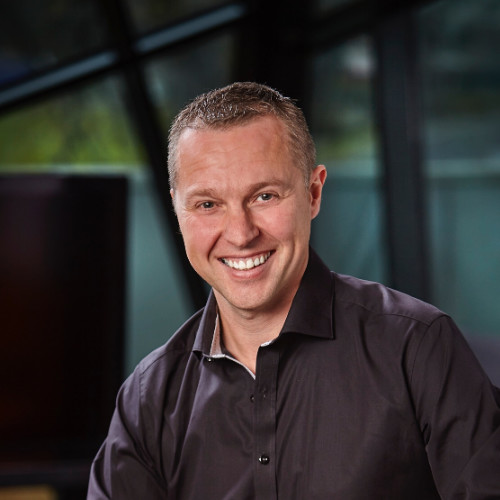



LH: What’s your take on autonomous mobility?
JB: I think autonomy will first take hold in commercial applications (long-haul trucking, taxis, and fleets) where maximizing asset uptime matters most. People will still want to own vehicles, at least for now. Driving is emotional. It’s identity. I’m a car guy myself, I don’t want to give that up.
LH: How does EV adoption affect your business?
JB: EVs are carving out a distinct market segment. The demographic is shifting - not just environmentally conscious drivers, but people focused on convenience and urban efficiency. Traditional manufacturers are playing catch-up while Chinese brands are bringing real innovation. It’s an exciting moment, and we’re building marketplaces to keep up.
LH: How did your role evolve?
JB: My journey started in control systems and hardware. I moved into software, then product, then governance and cyber. When I became CIO, I didn’t stop being a CTO -I added more layers. At this level, it’s about stewardship: guiding teams, managing risk, and enabling value for the business.
LH: How are you thinking about AI adoption?
JB: We’ve placed AI use cases into “no regrets” and “watch carefully” buckets. If it helps now (like transcribing meetings or summarizing documents) we use it. But placing big bets on fast-evolving tools? That requires caution. The market’s still sorting itself out. Pick your spots and stay agile.
LH: Is AI changing how people work?
JB: It’s like going from waterfall to agile: it’s not just process, it’s culture. But stigma is still real. Some people feel like they’re “cheating” by using AI. We need to normalize it. Like calculators, it’ll become second nature. The key is prompting, context, and value, not just output.
LH: How do you balance product development across regions?
JB: About 80% of our marketplaces are similar, but the remaining 20% matters. Regulation in the U.S. differs drastically from Brazil or Australia. So while we reuse what we can, we also adapt to each market’s legislative and behavioral quirks. It's part of operating globally.
LH: What shaped your leadership approach?
JB: I had a great early mentor who gave me confidence when I was just starting out. That stuck with me. Now I pay it forward, especially with junior talent. Helping someone build their foundation is one of the most rewarding parts of this job.
Host: Lucas Hendrich, CTO at Forte Group
Guest: Jason Blackman, Group CIO at CAR Group
Lucas Hendrich: Welcome to the CTO to CTO podcast, where chief technology officers dig into the challenges and opportunities leaders face every day at the intersection of business and innovation. I'm your host, Lucas Hendrich, CTO at Forte Group.
Jason, it's wonderful having you here. I think the audience will know a bit about you from your bio. You're the CIO of a holding company, CAR Group — is that the right way to describe it?
Lucas Hendrich: My first question: we're watching the vehicle industry evolve very quickly, right before our eyes. Pretty soon in Austin, Texas, you'll be able to take a Tesla robotaxi. How are you and CAR Group thinking about this, in terms of how you'll engage your market and incorporate that revolution into it?
Jason Blackman: It's an interesting question. Many moons ago now, I wrote a blog post on autonomous vehicles and their potential impact on the industry. I still believe that taxis, Ubers, and similar services will be affected first. So will heavy transport — long-haul trucking and the like — where you have a human in the loop and want your vehicles to maximize the value they generate for your business. Today you need multiple drivers to keep a vehicle operating 24/7.
Think of the airline industry. Airlines keep their aircraft in the air as much as possible, because there's a saying in aviation: if the prop's not spinning, the cash is burning. You have to maximize the value. I think that's where autonomous vehicles will play the biggest part initially.
I think people will still want car ownership, whether or not the car drives itself, and that will continue for some time. I spoke about this five-plus years ago, and I don't think much has changed since. Regulations are slowly catching up and so on.
But at CAR Group, we're always watching what's happening in the mobility space. What's our role in the future, and how will we stay relevant and be part of it? That's constantly in our ethos. Our culture has a degree of healthy paranoia, so we're always on the lookout for where the industry might turn and what path we should take. It's exciting.
Lucas Hendrich: You raise an interesting point. Autonomous vehicles will really serve the purpose of optimization. But the reasons people own vehicles are myriad.
A good friend of mine is a motorcycle enthusiast. When I told him I have an electric moped that looks like a Vespa — it's not a Vespa, but it's similar — he just found it funny. That's not why you have a motorcycle. You have a motorcycle to make some noise. It's a combustion engine; that's the aesthetic, the vibe, if you will.
So in a more optimized world, maybe autonomous vehicles just remove humans from the loop where humans aren't optimizing. But that has no bearing on the world of human preferences. What do you think?
Jason Blackman: You raise a good point. Look at my vehicles: they're certainly not optimized. Absolutely not. I don't drive many kilometers a year, yet I keep owning vehicles. Why? Because I like to go down to the garage, get in the car, and actually drive it. I enjoy it. It's almost part of my identity — being able to drive a car or ride a motorcycle. I don't think I'd ever want to give that up.
I'm 50 this year, probably in the latter half of my life. I'm excited to see where the technology goes, but I won't give up the excitement I get from the things I grew up with. That may change. Future generations may never own a car, motorcycle, RV, or boat, and never think of owning one. They'll always rent and use it in some more efficient way. But we're probably a few generations away from that.
Lucas Hendrich: We'll see. I agree. Change always feels fast, but adoption is incremental and slower.
Lucas Hendrich: My last question on the topic: there must be some aspects of the broad EV market — cars, motorcycles, even boats — that are changing things for you. Or maybe not. A Tesla factory is completely different from, say, a Ford factory that has to be retrofitted for EVs. Is there any retrofitting around selling EVs through your sites, or is it parts as usual?
Jason Blackman: I think there's a special place for EVs. It's a particular market, a subset of the broader market, with some special nuances. The demographic is obviously environmentally conscious, though we're also seeing EVs bought by people looking for convenience as much as environmental benefits.
Around town, an EV is great. In stop-start city traffic, you'd want an EV any day of the week. It's far more efficient and easier, with less wear and tear. So it's a good choice for efficiency in that regard.
I genuinely think it's a slightly different market, and we try to cater to it across our sites. We're certainly doing a lot more to improve that. There are many new entrants here in Australia, a lot of them from China. New brands have sprouted up, and they're really quite amazing vehicles. They're turning up the innovation stakes, so traditional manufacturers are playing catch-up in some respects.
We'll see how that plays out, but we'll cater to it in our marketplace. We're here to make buying and selling a great experience, so as new entrants arrive and new products come across, we focus on delivering outcomes for our customers.
Lucas Hendrich: It's important to note that you're in Australia and I'm in the United States. Our views are so shaped by our very different markets. I was in Thailand last year and saw many of the same Chinese cars and motorcycles. It's a whole new world, with a whole new set of preferences. We could probably spend an hour on that alone.
Lucas Hendrich: One last question on the topic, I promise, just out of curiosity. What inefficient yet fun vehicles do you own, if you don't mind sharing?
Jason Blackman: I'm probably one of the worst. I've had to buy trees to offset my carbon emissions. I'm an SUV lover; I like a larger vehicle. I'm a grandfather, and I like to drive my grandchildren around, so seven-seaters are my poison. They're all big cars: I own a Jaguar and a Land Rover, both in the family.
So I'm not the most fuel-efficient. But as I said, I drive very few kilometers each year, because I live in the city here in Melbourne and use public transport where I can. I try to offset the size of my vehicles that way.
Lucas Hendrich: That's great and fair. It's funny: having a seven-seater is still a challenge in our market. I moved to a Tesla in the past year precisely because my kids are past the age where they want to bring three or four friends along. Before that, we had a seven-seater that was like a school bus.
Lucas Hendrich: You're currently a CIO, and you've been a CTO. To frame the question: one aim of this podcast is to help a broader business audience understand what it means to be a CTO or CIO and what role we play. It varies significantly with company size. Being a founder CTO is totally different from being an enterprise CTO. And I think the CIO role is evolving. In some cases it's more aligned with the CISO role; in others it's an enterprise-level CTO managing several units.
We could go a couple of ways. What was your journey from CTO to CIO, what did you bring to the CIO role, and what does the CIO role mean for you now?
Jason Blackman: I'll start with my journey at CAR Group, because it's probably the opposite of what you'd expect. I think of it in five-year chunks.
In the first five years, we were in one data center. We had no international expansion and weren't in the cloud — AWS wasn't even in Australia yet; they were still building their presence. That period was all about technology: getting out of the data center and into the cloud, and preparing for international expansion. In that sense, the CTO role was about the technology: delivering performance, scale, the product, and scalability for our customers.
In the next five years, we were in the cloud and thinking about how to globalize. That's realistically when I transitioned from CTO to CIO, because I took on what you mentioned — the CISO responsibilities. I took on cyber, risk management, and governance alongside the technology focus.
Interestingly, we didn't replace the CTO. I took on the CIO title, continued in my old role, and added responsibilities like cyber. I think that's largely the difference. You can narrow the CTO role down, whereas CIO is broader.
Jason Blackman: We use the title CIO, but people still call me the CTO, the CPTO, the CIO, the group CIO. A title doesn't really mean much beyond what others immediately presume your role to be. For me, it's the mindset. What do I look after? What am I responsible for? How do I serve my CEO and board?
The role is self-defined in many respects, as many roles are, and I don't think you can pigeonhole anyone. But I agree that in the market sense, the CIO probably covers more governance and risk, whereas the CTO is more focused directly on product and technology. That's how I'd describe the difference.
Lucas Hendrich: It's interesting, because it almost seems every company has its own version of the role, depending on what it does. It's very different in a product company, a services company, a tech-enabled services company, or a pure manufacturing company.
My kids ask me all the time what exactly I do. The way I explain it: we have to see where technology creates leverage and growth in the business and be stewards of that. That includes innovation, but also the guardrails.
I can see how that stewardship evolved. Go back 20 years, and the CTO was configuring the servers and running email. So much of that is now managed by third parties or sits layers of abstraction away from hands-on work. Now it's about guiding technology in service of the business. I get that far with my kids before their eyes glaze over: "OK, but what do you do?"
Jason Blackman: It's not too different for me. For years, my kids thought all I did was play with technology: "He does something with computers."
I like the term stewardship, because it really describes what we do. Whether you're a CTO or a CIO, you're shepherding people along a particular path, providing direction, and making sure you and your team deliver value to the business and grow its outcomes.
For us, product and technology are very closely tied to the customer. Our product and technology are what's in our customers' hands, unlike in, say, a manufacturing business. That means we have real stewardship to exercise. We have to look after it carefully, because if we fail, the business is affected far more significantly.
Lucas Hendrich: You've mentioned product a couple of times. We've had guests who are or have been Chief Product and Technology Officers, or who moved from product into a CTO role. In a holding company with businesses in different parts of the world, I can see standardizing things like security, and you should probably have data governance standards. But product is so nuanced by market. Is the product function part of your purview? Do you standardize it, or have different guidelines for each region and market?
Jason Blackman: Absolutely. As I mentioned, I sometimes get called the CPTO — often enough that my product officers have probably heard the title misused, however you want to put it. But yes, I oversee product and technology across the group, so it's within my remit.
Each of our markets operates autonomously, with its own chief product officer. They join a monthly group get-together where we share ideas and collaborate. Part of my role is making sure that product development in, say, North America is shared with South America, Oceania, and so on.
We operate independently in our markets so we have flexibility and pace of change. Different things happen in different markets at different rates, and they're at varying levels of maturity. So we have the opportunity to bring low-hanging fruit to markets in South America, for example, that are less sophisticated.
It's an interesting role as a result, and it makes it more exciting. Having the chief product officers and chief technology officers across the group come together regularly, led by me, gives me visibility into what's happening across all our digital assets around the globe. And there's a lot going on, I'll tell you.
Lucas Hendrich: In terms of responding directly to markets — features customers actively ask for, or that show up in reviews — is it roughly 80% similar and 20% outliers? How much variance do you see from a feature perspective? These are all essentially mechanisms for digital marketplaces where goods change hands. Any crazy outlier features from particular regions?
Jason Blackman: I think 80% is similar, no doubt. That's how we leverage capability across the group, and it's an efficiency we gain from our size. But each market has its nuances.
In the US, you have 50 states plus territories, each with its own legislation. We rolled out payments here in Australia, where financial services are regulated at the federal level, with very limited state-based impact. In the US, it's a mixed bag: every state has its own rules, and the federal government adds elements of oversight too.
So it's a whole different game. We want the same outcome for our customers, but we're playing in an entirely different landscape and have to cater to that, which makes it more complex. Brazil and Chile have their own nuances too. Most of it is legislative, no doubt about it.
That's just part of doing business in each market, but it makes it much harder to lift and shift products from one location to another. The beauty is that the core is very similar. All customers want to transact. They want to pay safely and not be defrauded. All of that carries through; it's just how we go about it. Same outcome, but the steps are different.
Lucas Hendrich: You're absolutely right. In the United States, each state adds a layer of complexity, and payments in general are complex. This may be more of a general macro business question, but it seems Latin America does a better job of removing customer friction around payments and transactions.
I'm excluding imports and exports. I lived in Argentina for about a decade, and there were lots of complications — just getting a laptop shipped to me, for example. But paying for goods within Argentina was very much facilitated by the ecosystem around Mercado Libre and Mercado Pago. Do you see that too, or do you think they're on par?
Jason Blackman: No, absolutely. Their government structures are actually somewhat simpler than the US, which probably has one of the more complex setups from a government point of view.
Even in Australia, we have the New Payments Platform. You can transfer money between banks just by sending it to someone's mobile phone number — we call it PayID. Sending money between people is super simple and super fast. Sure, there are transaction limits and so on.
But people look for an escrow service, so you don't send the money before you get the keys. That's the level of protection we offer in our products, and why we have a payment service. Transferring money is really easy, but how do you do it safely and make sure you actually get the goods?
In Latin America, we'll provide the same capability, and we're finding it far easier to implement there than it would be in the US, purely because of the complexity of US legislation. I totally agree: transacting in Argentina, Chile, and Brazil is far easier.
Brazil has a fantastic capability. You have the equivalent of a Social Security number, and you can get pre-approved for finance on the basis of that number alone, because they have all your data. Bang — no filling out miles of paperwork. That's a complexity we have in Australia: you have to prove your income versus your outgoings, and your asset base, to get finance. Every country has its own complexity, and as a global marketplace provider, we have to cater to it.
Lucas Hendrich: Absolutely. Our resources are global too, so it's interesting that you share the observation that there's less friction in Latin America around payments and transactions. I think the United States could learn a bit from that.
Lucas Hendrich: I won't get into how any industry is being affected by decisions coming out of the United States right now, knock on wood. Instead, let me change tack to the topic everybody wants to talk about and nobody wants to hear more about, because it's so played out. But I think we're still in the very early stages of the potential of generative AI and classical AI.
I think we're at an inflection point. No one really knows what next year will look like, which is both exciting and terrifying. I'm curious, not so much from a product standpoint as from a ways-of-working standpoint, how you're approaching it at a global level.
There's a temptation to run fast. Yet everything is moving so quickly that it's like trying to jump onto a train from the roof of a car going 120 kilometers per hour on a busy highway. Where do you jump on? Once you're on, what do you commit to? Do you stay, or jump back? I don't know if the metaphor fits, but that's how I feel whenever there's a new model or capability. How do we institutionalize it in the organization, which takes time?
Jason Blackman: The analogy's not bad. I think of it as "no regrets." You can turn on AI features in products you already use with no regrets. They may or may not help your people be more efficient or improve their working lives, but you can turn them on and off. You might pay a little — usually a few extra dollars per user per month for the AI capability. As long as you've done your due diligence — where does my data go, is there any possibility of data egress, and so on — there's no real harm in many of those capabilities. They're in the no-regrets bucket.
The problem comes when you invest heavily in a particular technology. The pace of change right now is so great that we could make a wrong decision — place a wrong bet. That's the juggling act I think we and many other businesses will be doing over the next two or three years, maybe even just one or two, until the Betamax-versus-VHS scenarios play out.
Then you'll see the dominant players cement their market positions, the pace of change will ease or plateau, and people will have a chance to breathe. Billions are being invested in these models, and they're constantly changing. Gemini, Perplexity, Claude, you name it — which one do you invest in? And next week there's another one.
So you may want to do a little with a lot, and keep your powder dry, ready to shoot for the moon when things stabilize. To be clear, I'm definitely not suggesting not investing at all. It's about how you pick which horse to back right now.
Lucas Hendrich: Precisely. I like how you put it, and I think there are two spheres. On the no-regrets side, I'm spending a lot of time, including overtime, playing with as many things as possible, trying to find the value and understand how they apply in really small chunks.
Thinking about this from an AGI perspective is probably pretty damaging if you're trying to run a business. You have to think about the discrete problems you're solving and the incremental gains. And I think the low-hanging fruit is being picked pretty quickly. That's the no-regrets side: I'll feed these meeting notes to an LLM and create a plan, because it saves me 10 minutes.
The hard part is that I think this will change how we work, in a way similar to the shift from waterfall to Agile. That was a whole working culture: how we think about products, productivity, and approaching complex problems. (My internet's a little shaky, so I hope you can still hear me.) It even changes how we estimate, document, and create roadmaps. The timescale is shifting.
Maybe the result is that the chunk of work we can feed to agents gets done in one cycle, while the harder, more ambiguous human cognitive work still happens in two-week sprints. Or maybe that other work is planned differently, or done ahead of time. I'm not sure what it will look like, but I feel this kind of major shift will have an impact similar to how embracing Agile affected software development. What do you think, and how do you think about rolling it out?
Jason Blackman: With AI and all this tooling — and with any emerging technology that comes down the pipeline over the next five to ten years — one thing we always have to think about is behavioral change in people. I agree 100%: it's a revolution, like going from waterfall to Agile. That changed how people thought about rolling out a roadmap and how they might pivot. The ability to pivot when new information comes to hand changes how you behave in the workplace generally, and how you put things together. AI will be the same.
We had an interesting conversation with the board recently about AI. One thing that came up is that there's still a stigma attached to using it. Did you cheat because you used it to compose or translate an email? It's crazy that there's still this perception that you're not doing your job if you're using AI. It doesn't correlate.
So I think the first thing we have to do is get rid of the stigma. I'm seeing that in education, where teachers are now saying, "Use AI to help formulate your answers and establish your thinking." You move from just generating artifacts — which is easy — to focusing on the thinking itself and the value you contribute to the conversation with the AI.
Then prompt engineering, linguistics, and all of that will become training we roll out so people maximize the value they get from the investment. But I absolutely feel there's still significant stigma around using AI to your advantage and for efficiency in day-to-day tasks, personal or professional. Address that, get it out of the way, and then I think we'll be well on our way to taking full advantage of it.
Lucas Hendrich: I totally agree; that's an excellent point. Children illustrate it very well. High school kids — maybe this is just my view, because my kids are in high school — are in a terrible position right now. They have all these tools at their disposal, but they're in a system that hasn't adapted to them yet.
So it's really hard to teach them: be curious, use these tools to help you learn and get the busywork done, because they do that really well, so you can focus on the hard things. At least in the education system I grew up in, there's a lot of busywork, which leads to memorization and rote learning — though you have to start somewhere.
That's how we're embracing it culturally: if an LLM can do it, absolutely embrace it. That's not replacing you. It's taking that part of your job off to the side so you can focus on the really hard stuff.
Jason Blackman: Think about the invention of the calculator. People would have thought it was cheating to use a calculator instead of doing the math themselves. Now, why would you add things up without some kind of tool, whether a calculator or Excel? Nobody bats an eyelid, and nobody shames you for using those tools to your advantage. I think AI will come full circle and have the same impact.
Lucas Hendrich: I heard something funny recently on another podcast. When electricity became widely used, there were news reports about freak accidents — people getting electrocuted and all these risks.
Obviously, knowing how to write code is incredibly important for understanding architecture; I could go on and on. But at some point, the physical act of doing it is like making candles. It's a great hobby, but it doesn't scale, and you're probably better off using light bulbs than candles in your house. I think it's a similar kind of shift.
Jason Blackman: Absolutely.
Lucas Hendrich: The last thing I want to ask about is fascinating, because everyone on this podcast has such a diverse background. People come from aerospace, mechanical engineering, philosophy, liberal arts, even creative writing — all paths to technology. That makes it even harder to explain to our kids how we ended up doing what we do.
There isn't necessarily a natural trajectory where you study one thing, then the next, and it all builds. Partly that's because technology changes so quickly that you need to balance it with applied business knowledge. And you have to be multidisciplinary in anything involving product, because you need to understand human behavior to some degree.
So tell me about your journey from post-high-school education into your career, and maybe one or two mentors who shaped your mental map of what it means to do what you do now.
Jason Blackman: That's a good question. We're going back 30-plus years now — you've turned the dial back.
After high school, I went to university to study electrical engineering, but I didn't finish that degree, because I moved to Australia for work. I grew up in New Zealand. I started out designing control systems and electronics — real engineering roles.
Then I moved from hardware into software, because that was obviously where things were heading. Computers were becoming ubiquitous, and I could see that happening. I moved into software and did a lot of consulting. I eventually finished a degree at RMIT here in Melbourne, and then did an accounting degree to build business capability — to understand how businesses operate.
So my path went from hardware — designing electronic circuit boards and programming microcontrollers — through software development and engineering, to the advent of the web and online digital businesses. Now I lead a global team in an online digital business. The journey has been quite varied: finance, utilities, defense, you name it.
Jason Blackman: It's hard to describe the perfect career path, because everybody's has twists and turns. It's all about timing and where you are at a particular point in your life.
I had kids early, which meant I didn't travel when I was younger. I had a young family, but it meant I could immerse myself in work. I focused on family and work, and travel would come later, which it has. I now have adult children, and I can lock up the apartment in the city and head overseas for a good holiday.
Other people have children later in life and travel early, so their careers may be a bit more stop-start. I had that stability early on, especially in my 20s, which let me grow and build my professional capability. Different people do it in different ways.
Jason Blackman: To come back to your point about mentors: they come at different times of your life. Early in my career, I remember distinctly a gentleman named Michael Kelly. He was effectively my manager at an electronics manufacturing business, and he was great. He taught me a lot and gave me the confidence to grow as an individual. That was in my early 20s, and it really set the foundation.
I think about the impact he had on me throughout my career, and the focus I now put on individuals, especially junior people right at the start of their careers. I think about the transformative difference I can make at that stage. That's their foundation, and from there they grow and take on other mentors throughout their journey.
I really enjoy staying in touch with a number of people I've played a key part in developing and seeing their progress. Some have gone overseas and come back to Australia, growing in their careers and as individuals. I get a lot of joy out of seeing that evolution.
Lucas Hendrich: I totally agree. I think it's important to have a mentor who's senior to you, whether you measure that in years of experience or actual years. I have a mentor who's 10 years older than I am, and I mentor someone about 10 years younger. That person provides a feedback loop I learn from too, because I don't see the world the way I did 10 years ago, and the world has changed. It keeps you in touch. That's a general practice I try to follow.
If you ever have the chance to help someone in their career with a mental model or framework — anything that gives them a bit of leverage going forward — it's great to see them take advantage of it.
Jason Blackman: Absolutely. It's part of the joy of the job.
Lucas Hendrich: And I have to say congratulations — you mentioned you're a grandfather.
Jason Blackman: Thank you. I have two little gremlins in the family: my grandson, who's nearly three, and my granddaughter, who's just past nine months. They bring a lot of joy.
Lucas Hendrich: And you can spoil them, because you don't always have to be the one putting them to bed. It's not like your own kids, where you have to be rigid and disciplined.
Jason Blackman: That's right. We don't have to parent them; we're just grandparents. I love it.
Lucas Hendrich: Jason, this has been a real pleasure. I wish you the best of luck going forward, and keep having fun with vehicles. One thing AI will not replace is the very human preference for hearing an engine roar.
Jason Blackman: I won't be giving up my supercharged V8 anytime soon, because the sound is absolutely glorious. It's a preference. I've really enjoyed the conversation. Thanks for having me on your podcast.
Lucas Hendrich: Thank you, Jason. Take care.
That's it for this episode. Join us next time for more real-world conversations between technology leaders. And if you liked what you heard, subscribe to CTO to CTO. See you soon.