


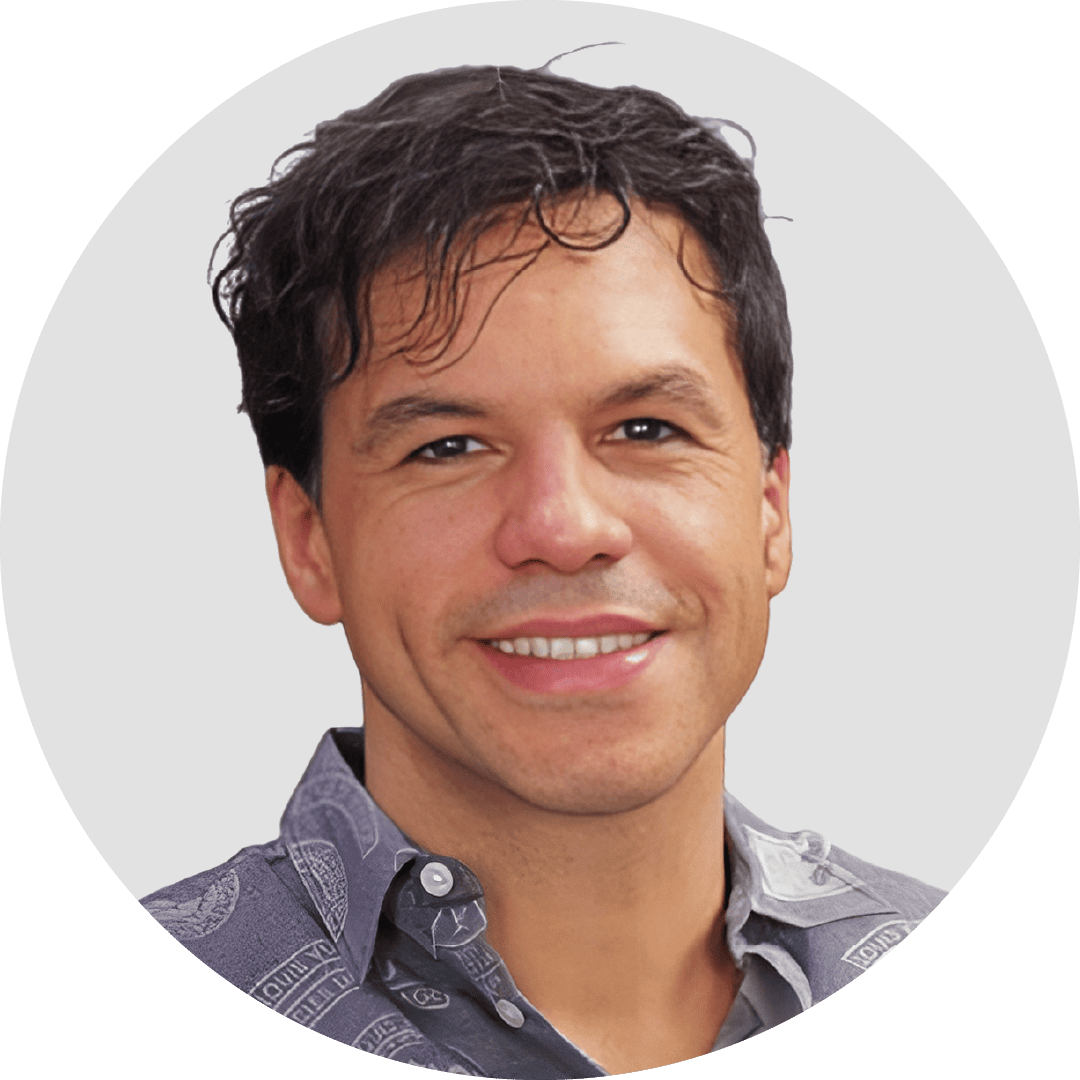



Christopher shares his personal journey from studying Romance languages to leading IT at one of the world’s most iconic fashion houses, and why, at the end of the day, it’s all about people.
They talk about building trust through security, how blockchain plays a role in storytelling, and the power of leading with empathy. Here's a recap of their conversation:
“Even though the title says otherwise, it is less about technology and it is more about people.”
At Louis Vuitton, every tech leader is expected to think beyond systems and tools. For Christopher, innovation begins by listening to people, understanding their needs, motivations, and aspirations.
“It’s always about people first. And then being that interpreter to understand those things and doing something with it, in a small scale to a bigger scale.”
“Security's not a person, it's not a CISO thing, it's a everybody thing.”
Christopher shares how security is woven into every part of the organization, from the contact center to logistics. It’s not just about technical controls, but about culture and shared responsibility.
“You want to protect it the same way you’d protect your own. And now everyone in our team is an ambassador in one way, shape, or form for security.”
“People assign value to an object when they understand the story behind it.”
Louis Vuitton uses blockchain to capture the provenance of products, not just to track inventory, but to reinforce storytelling and trust.
“Knowing the provenance of supplies, materials, which artisan touched something; it’s embedded in the organization. That’s what gives legitimacy and reinstalls trust.”
Christopher reflects on growing up in Queens, studying languages, and thinking his skills were “just a good party trick.” But they turned out to be the foundation of his leadership.
“When you speak someone else's language, you build a connection. And that connection is a springboard to the next best thing.”
Host: Lucas Hendrich, CTO at Forte Group
Guest: Chris Penido, CTO at Louis Vuitton
Lucas Hendrich: Welcome to the CTO to CTO podcast, where chief technology officers dig into the challenges and opportunities leaders face every day at the intersection of business and innovation. I'm your host, Lucas Hendrich, CTO at Forte Group.
Bienvenidos al podcast CTO a CTO, primera vez en español. We have the great honor of having with us the CTO of Louis Vuitton, Chris Penido, and we're thrilled to have you here.
One theme of this podcast is that "CTO" means many different things. Being a founder CTO, a startup CTO, a CTO at a mid-market PE-backed company, or a CTO at a large enterprise or retailer are all totally different jobs — at least that's what we've observed. So it's great to have someone from a very different context than any of our previous episodes: on the one hand, an incredibly well-recognized brand; on the other, a very large enterprise operating in 70 countries.
Chris Penido: Thank you very much.
Lucas Hendrich: Along the lines of multidisciplinary backgrounds: I've shared on this podcast before that mine isn't very traditional for a CTO, and yours is, I'd say, closer to mine in being non-traditional. A liberal arts background, studying romance languages and literature.
I'm really curious about that journey and the insights it's given you. I'm also curious where you've felt you had to teach yourself, or find ways to make up for not having a technical background. I like to talk about those challenges openly, because it's a surprisingly common theme: people reach technology executive roles from wildly diverse backgrounds, from physics to molecular biology to romance languages.
Chris Penido: I hope I remember all of that, but I will. Hi, I'm Christopher Penido, CTO at Louis Vuitton. I've been there almost 13 years now.
How did I get here? To be honest, I didn't even know I could. I probably wouldn't have bet on getting here, even if I wanted to, given what I went to school for. Growing up in New York City — Jamaica, Queens, in particular — opportunities like this always seemed outside the realm of possibility. You'd see it on TV and hear about it, but never thought you could actually be it. Sometimes you think you need to settle for less, keep the dream in the back of your mind, and pursue it someday in your own way.
Over time, I realized I didn't have to settle. If I truly worked hard toward the goal, I could get there. I had a "too school for cool" mindset, which definitely made high school challenging. Being a Star Trek nerd and all the rest — nerd fandom would probably tell you you'll be typecast like that for life. But it was actually a good foundation. Being a futurist, thinking about technology and a better world through technology and collaboration, ironically propelled me further down this path.
In high school, you don't know what you want to do. You just take a language class here and there. I got stuck in French, because I wasn't allowed to take Spanish — it might have been too easy a grade. And of course, I hated French.
Lucas Hendrich: But you pronounced "Louis Vuitton" impeccably.
Chris Penido: That I did. I've always been in the situation of making lemonade out of lemons. At first I wasn't enthused, but when life presents you with what it has essentially chosen for you, you either adapt and adopt, or you stand your ground. Standing my ground felt like giving up and being immobilized, and that's just not who I am.
So I decided to spend the whole summer watching TV5 — channel 25, free for 30 minutes — so that when I went back to school, I might actually know what I was supposed to be learning. I could see the difference that giving up a little of my time to learn something new made. I went from straight Cs at the beginning to As, which I never thought would happen in a class like that.
Chris Penido: That carried me into college, where I kept taking French, since you still had to take a language. I was leaning toward an international relations career, which sounded great and so cool. Maybe some history, maybe a double major in French and Portuguese to make it even more interesting — though that didn't exist at NYU at the time.
I quickly realized that international relations, while noble, was a great career path for someone with the means to survive on that salary. In my situation, it wasn't going to put bread on the table. But I didn't want to lose something I loved. If you love something, you have to find your own path to expressing it.
Throughout high school and college, I was trying to get through my classes while making ends meet working in a computer lab. As a kid, I loved tinkering. I'd soup up my computer and get the best 2400 bps modem just to connect to AOL. Connecting to the world was so fascinating to me. So when the chance came to earn what I thought was a very decent hourly wage in a computer lab, I took it. It helped pay for my studies and textbooks.
The more I got into it, the more interested I became in systems administration, running these facilities, and locking them down. Around that time I leapfrogged into network security. It started finding me more than I found it. I got a role at NYU in network security, where my job was developing training materials.
It stuck with me. After graduating, I went to Columbia to keep working in IT on the service desk, which also helped me go back to school — I had plans to do a master's. After a while, NYU called me back, and I returned to network security: standing in front of audiences, training them, trying to make 300 people laugh about network security and feel invested in it. I wouldn't have bet in my favor on that. I seriously thought it was impossible.
Chris Penido: But having done it and practiced it so many times, I applied what I'd learned during six months studying abroad in Paris — standing in front of the class every day, presenting your homework, addressing an audience and actually knowing what you're talking about. I brought that to my NYU role, talking to audiences of 300, 500, or a thousand people as if I were talking to you.
That gave me the courage — the professional stamina — to think, "If I can do that, what else can I do?"
Lucas Hendrich: Yes.
Chris Penido: That's when I made the leap to apply outside that domain, and that's when I found Louis Vuitton. To be honest, until then I thought knowing French was just handy for knowing when a Francophone or Creole speaker on the subway was saying something funny about me.
After I came back from Paris, I had roommates in New York for about 10 years, and in that time I learned French in New York City — in Queens. That's the first thing people ask me about. I just thought it was a good party trick.
But when I applied for the job, I realized for the first time that all these skills — the international background, studying abroad in France, speaking French, graduating from NYU, working at Columbia, and having a technology background — added up to a niche I hadn't realized was unique.
Lucas Hendrich: That's another theme. Other guests have had similar journeys, in the sense that you don't anticipate where you're going, but you're heading in a direction. What leads you there are capabilities, skills, attributes, and passions you may even undervalue, because they come so naturally. Then you get into different kinds of companies, especially in the corporate world, and realize that what comes easily to you has a lot of value.
It's inspiring, and I hope people entering the workforce have similar opportunities. I feel incredibly blessed. I certainly didn't envision being a CTO 20 years ago, but I was tinkering with technology too, and back then you could find a niche in many companies bridging technology plus something else. In your case, it sounds like technology plus the ability to communicate difficult concepts across cultures, which many people struggle with.
Lucas Hendrich: Tell me if I'm making the wrong leap here, but at a company like Louis Vuitton, protecting the brand must be paramount. To what degree do you operate more like a CISO than what might be considered a typical CTO, heading up development and the like? How is your time divided? Are you more security-focused? Is that the right intuition?
Chris Penido: From the day I joined, because of my previous role, I had to apply everything I knew from network security. Day one, I was helping us move data centers and rewriting all the firewall rules for things that apparently no one had documented before me — always a fun exercise. I helped us develop a P2PE platform for payments on our most valuable part of the business: the transactional side, plus customer data and client relationships. Everything I'd learned in previous roles, from PCI compliance to NIST and other frameworks, came into play.
One challenge throughout my time at Louis Vuitton is that one part of your brain is always saying, "Dream the impossible. Do the next big thing no one's seen. Elevate the experience and wow them." The other part says, "Do it carefully and securely, with enough thought to recognize that, as much as we want certain things, we can't compromise on security, people's information, or their privacy."
The brand's reputation is so well known that you feel as invested in protecting its identity, client information, and relationships as you would your own, or your parents' or family's. If they asked you how to use "the Googles" to do something, you'd almost say, "Bless your heart, but let me take care of it." You want to protect it, because some people may have a different idea of what's safe and what isn't.
Chris Penido: I think things are great right now. We have a fantastic CISO, Davin Dart, who has made it possible to educate people at every level of the organization: the contact center, manufacturing, logistics, corporate, and so on. We just had a great cyber month, and I was blown away by the speakers, concepts, ideas, and training. Security may not seem like a sexy topic, but it can be fun and dynamic, especially when you see how it applies to your own world.
We also have a framework within our organization to avoid things like shadow IT. As projects come up, there's a set pathway everyone follows, working with finance, procurement, and IT, and we funnel things through the right channels. That replaces people popping up in the middle of a meeting saying, "We deployed this awesome thing that does this stuff with client data," while I sit there thinking, "I have no idea what that is."
I had those deer-in-the-headlights moments at different points in my career, but they no longer happen, because we've collaborated to make sure things don't get to that point. We go through the right frameworks to analyze the confidentiality, integrity, and availability of data, and make sure everyone in the room understands those concepts at different levels.
It's one thing for me to tell people; it's another for them to self-police and recognize it themselves. I think that's the highest level of achievement on this topic. Every member of our team is, in some way, an ambassador for security. Security isn't a person or a CISO thing; it's an everybody thing. No one's perfect, but we've put real effort into technical controls that prevent the "oops, I made a mistake" moments, while reinforcing the message in a learning, teaching environment that helps people think about these things in daily life.
Lucas Hendrich: Just in time for ChatGPT to come along and make it even more challenging.
Chris Penido: I don't know when this podcast will come out, but if you haven't tried Gemini 3 — you think ChatGPT is something; Gemini 3 is on a whole different level. I think the aliens might actually visit us now. It's insane.
Lucas Hendrich: It's interesting that we met at an event about AI and security. My next question is about another emerging technology: blockchain. I don't know of any other well-known company actually using blockchain in production and delivering value. What can you tell us?
Chris Penido: I think it shows that, from the beginning, an organization like ours sees the problem not just for itself but for the industry as a whole. When you look at the Aura Blockchain Consortium and the companies involved, it's not just an LV or LVMH thing. It's about how anyone knows the authenticity and traceability of these items.
What most people don't realize is that even within our own organizations, knowing the provenance of supplies and materials — which artisan or craftsman did or touched something — is embedded in the organization. Without that, funny things can happen in the worst ways. The product you sell a client is really the culmination of the story of an individual's craftsmanship: where it came from, who touched it, at what step in the process, and who owned it.
It's all part of the storytelling, and people assign value to an object when they understand its story. Knowing all of that, with assurances behind it, builds legitimacy and reinforces trust in the object.
Chris Penido: So much of what we do in security is about trust: instilling it, maintaining it, and protecting it. That's paramount in everything we do, especially in luxury. Breaking trust is like breaking a Fabergé egg. You can try to repair it, but a true craftsman will always spot the cracks and know there's a weakness somewhere. We don't take that lightly.
That's why we take extra precautions with items like diamonds and high jewelry. You want to know the provenance: whose hands have touched it, and where it has been. So much of that is what you bring to the table when you meet a client and tell them the story behind the piece they're looking at.
I think people lose sight of what luxury is. From the outside, they might see high-priced items, big sales, and money. It's not about that at all. It's about craftsmanship, storytelling, and meaning. We don't do things just for the sake of it; we do them with thought.
It's not about volume; it's about relationships. It's not about transactions; it's about authentic connections between us and the client. We'd never push something clients wouldn't want for themselves. We're trying to give them an experiential moment. And that's what blockchain reflects: the level of trust we've built into it.
Lucas Hendrich: That's interesting, because for many of our listeners — and at companies where I've worked — the North Star metric might be user adoption, to reach the first stage of growth, or something tied to whatever economic unit you're transacting. Being a CTO at that kind of startup is almost simpler in a way. Not easy, but it's about getting it right and then scaling it.
What you're describing is totally different: products with history and story, and actual physical objects. So how much time do you spend on innovation in terms of knowing your customer, and how are your teams bringing AI to that?
Chris Penido: I joke with people who ask a question similar to one of your original ones: What insights have you gained in this CTO role compared with your previous role? Ironically, even though the title says otherwise, this role is less about technology and more about people — their relationships, their expectations, and helping them meet their aspirations. That's where technology, people, and innovation intersect.
I make it a point that the basics are covered. The lights need to be on, and our applications and systems need to do what they're supposed to do. But everyone — in service delivery, operations, networks, digital experience, and workplace — has a piece of the innovation pie.
It's about responding to business needs, and knowing what those needs really are means talking to your peers. It means stepping into the real world, putting yourself in the client's shoes, having those experiences, and translating them into technology that facilitates them — not artificially, but in a way that's conducive to them. Again, it's not about transactions; it's about authentic experiences.
Chris Penido: Every member of our team has an innate innovation compass, and they bring ideas to the table. We look at those across the wider portfolio and divide up the tasks among teams. At every stage, technology, people, security, and everything else are taken into account.
I'm fascinated by what I've seen come out of our New York offices and the wider LVNEO team, the IT organization within Louis Vuitton. Countless times, we've taken ingredients everyone else has seen — some cheese here, tomato sauce there, flour and water — and where everyone else sees ingredients, we see a pizza. Putting them together to create something new and unique, and being first to do it, is always the challenge.
I've had the pleasure of seeing that happen many times. It's about nurturing people's curiosity, giving them room to express themselves, and basing it on trust in both directions. When people are given the latitude and space, and you show you believe in them, they can do things wildly beyond what anyone could imagine.
Lucas Hendrich: Here's a curveball. One question I like to ask is: What book, essay, film, or anything else changed how you see things or how you think? People usually name something technical or product-related — part of the canon of the CTO library.
But listening to you and thinking about your background, have you ever recommended a work of fiction to people? If you study computer science or any technical field, there's a whole canon, with frameworks and shared ways of understanding the world, and you can go back to first principles and the laws of physics. But when it comes to telling stories, nothing beats fiction; it's essentially narrative. What books do you recommend to your staff that aren't from the management-school shelf?
Chris Penido: I've seen with other people that they absorb the lessons they need through whatever they see, feel, and hear that inspires and galvanizes them. I think it's impossible for me to tell anyone, "Read this book and do this," or "Go see this film." I'm sure you feel that too. To each their own, whatever the medium. I can only speak for myself. I know that's the typical, corny answer, but it's true, and I believe it.
What really pivoted my career, and made me the person I am — how I think, how I operate, talking to people first and putting technology aside, because technology is never what matters; it's always people first, then being the interpreter who understands things and acts on them, small scale then bigger — boils down to one or two people in my life. One in particular.
When I first applied for this role, I'd done the interview, but I still felt I wasn't worthy of it. That person later found out and asked, "Why didn't you tell me? I would have coached you so well." I said, "I just wanted to get my foot in the door first and not waste your time."
He looked at me and said, "OK, what's the next plan?" I asked, "Why are you so invested in my applying for this role?" He said, "Because I'm your best friend. And as your best friend, I'll be your worst critic, because I want the best for you. I also know your worth. What you can do will blow that company away. You have abilities that may not mean much to you, because you're used to them, but to everyone else they mean the world. And you're just beginning to use them."
Until he said that, I wouldn't have believed it. Honestly, I was just Joe Schmo from Queens who knew a little IT and spoke one or two languages. To me, that didn't mean anything. Who in Queens doesn't have that on their résumé? But hearing it from him, with that conviction, I actually felt it.
Chris Penido: I know most people embellish their résumés, and "fake it till you make it" is true for everyone. But I'd actually undersold myself. When I got the first offer, I was ready to grab it and run. I went back to my friend, who was coaching me, and said, "I got it!" He said, "Great. Refuse it."
I said, "What? I didn't think I'd even get this far." He said, "No, you have to refuse it. Accepting the first offer is just bad negotiation." I said, "I don't think you understand. I've never had an opportunity like this." He said, "You're worth more than that, and they need to understand that. You need to go higher."
So I refused the first offer, thinking, well, it was nice to try. And lo and behold, a second offer came in. I said, "Wow, that's insane — a better offer and a better title. Let's go." He said, "Nope. Refuse that one too." I said, "I don't think you get twosies." He said, "You have to. If you don't know how to negotiate for your own life, how can you negotiate for something as prestigious and important as Louis Vuitton? That's the test."
And guess what? He was right. After I refused the second time, I got a third and final offer. I said, "All right, we're good now, right?" He said, "Do it — but wait until Monday." It turned out to be the best decision of my life.
It was the springboard that set the tone, both in how the company saw how seriously I took myself and the role, and in showing I wouldn't settle for less. That's part and parcel of the brand's identity and DNA. It's not just about travel or fashion. It's about doing things thoughtfully and exquisitely, reaching for the highest possible excellence, and applying that to yourself.
Even when everyone tells you something is impossible, only you hold the cards. There's a French phrase: Quand on veut, on peut — when you want to, you can. And even in failure, there's success in having tried. That was the turning point of my career, and it's what I try to instill in everyone. It's why we've been able to push the envelope on innovation so many times.
Lucas Hendrich: So was day one daunting?
Chris Penido: Yes, because maybe I'd embellished a little on the networking side. My first job was to configure a switch and ship it that same day, because we had a pop-up opening in San Francisco the next day. I thought, "Great, this is wonderful." Everyone left, leaving me a Cisco 3560 switch and its power cord on the table.
I grabbed my keyboard and moved my monitor over, thinking, "Where do I plug in the keyboard and the screen? Where's the GUI?" Shortly after, I realized, "This isn't going to work at all." A couple of YouTube videos later, it turned out I wasn't so bad at setting up a switch.
It taught me that, in today's world — going back to your original question — information is so democratized and accessible, especially now in the age of AI, that it's really about going out, finding the information yourself, and doing something with it.
Chris Penido: And that comes from having a vision. I came from humble means and I'm grateful for everything my parents gave me. But if I wanted something, I had to build it with Legos. If I wanted a Super Nintendo: Legos. A Sega Genesis: Legos. That's what my mom always told me — I had to build it myself. You could almost see the house or the car you were building in the Legos, and you used any piece you could to make it happen.
Just as I did as a child, today I can see what will be. I just need to figure it out collectively with our teams, co-creating it. It's not about me or any one person. It's about co-creating a shared vision. As long as we share that vision and it responds to a need, we can build the strategy together, and everyone has a voice in the tactics we use to achieve it. Honestly, one of the greatest rewards is seeing the crowning moment when you've built that house, whatever it may be.
Lucas Hendrich: And you create a space where people can do that authentically. In my first job, my first supervisor told me something very wise that I carry everywhere: not everyone shows up to work for the same reasons.
You may or may not agree with Elon Musk on many things, but one thing he says about companies — I'll paraphrase — is that it's about getting all the vectors pointing in the right direction. Every person is a vector heading somewhere. How do you channel and align that? What tricks or tools do you use to get that alignment for co-creation with your teams?
Chris Penido: Sometimes you just have to buy them lunch — that helps a lot. But one technique we use: there are times when you have a vision in your mind that only you can see. So, at a very rudimentary level, we show a simple roadmap. It literally looks like an Excel sheet with some squares. We talk about the different streams, what each should achieve by the end, which member of the management team runs each portfolio, and who in their team will carry that stream to its fullest conclusion.
By stringing all of that together in sequence, everyone sees the same thing. Every two weeks to a month, we sit down, look at the roadmap, and never lose sight of it. We make sure we're on target, and we signal to each other: "I'm going to be delayed, so you need to move faster to make up the difference."
It's like a relay race: whenever one piece depends on another, we let each other know. That synchronized, collaborative work instills in people the importance of what they're delivering. I think for individuals to achieve greatness in what we do, they need to be able to answer the five whys: why are they doing this, why are they delivering it? If they know that inside and out, achieving the vision together is as easy as walking down the street, because everyone is invested. They have to see as much of themselves in it as they see in the solution.
Chris Penido: Having that co-ownership and shared vision of the roadmap is rewarding when it manifests. Take our Fifth Avenue store. It was one of the first on a point-of-sale platform we worked very hard on, running fully in the cloud, with iPads in the store replacing big, clunky POS systems.
Ironically, it came from a single idea: What if, instead of building these clunky devices, we created a space that today might be a POS, and tomorrow might just be you and me sitting together having a nice conversation? I might be showing you wedding bands for your future marriage, or the handbag you're going to give your daughter for her birthday. Being able to reuse that space to create connections and experiences is the vision.
How do you get there? We had to completely break everything we did and redo it differently, just to achieve that one experience. We can talk about how much square footage we saved, or how much selling floor we regained — all true. But it's about the experience. We're making it about the client, not the technology.
Lucas Hendrich: And it's a physical experience.
Chris Penido: It's a physical experience, yes.
Lucas Hendrich: In a purely technocratic view, people might think that's on the decline. But it's not.
Chris Penido: It's not. If anything, in the age of social media and doomscrolling, people — surprisingly — respond when they get a taste of a truly experiential moment that's different from what they've come to know and accept. If it's done with enough thought, care, and personalization, it draws them further in that direction. You see it in how post-pandemic travel has exploded. People appreciate that time is short and life is short, so go out and enjoy it.
There's a time and place for acquiring luxury items that have a story and meaning and are made with thought, and balancing that with experiences — especially combining the two — is a novel approach to answering the question: How do you create a connection with someone without making it transactional? People feel disconnected even though they're more connected than ever, and they're still looking for connection in different ways. It's our job to inspire them to find it.
Lucas Hendrich: That's interesting, especially when I watch my kids get into the brain-rot cycle; there's anxiety there. What you're describing is the antithesis of anxiety. It's rich. It's not something you digest quickly in a seven-second hit. You sit down and experience it. That's inspiring.
Lucas Hendrich: One thing I think about a lot with AI and automation is that there's a direction that feels inevitable — though I don't believe it is — toward ever greater automation and removing the human from the loop. But at the end of the day, we're not making products for AI. We're making products for humans. Human preference still determines whether someone buys something, and you can only automate so much of an experience.
I'll gladly outsource research to ChatGPT or whatever foundation model can tell me where the best-value hotels in Porto are. But I don't necessarily want an agent to book my flight. I may want to look at the seat map and pick a window seat for that trip, against my normal pattern. So this affirms my intuition that as long as there are humans, we'll be making experiences for humans.
Chris Penido: I agree. We're in an era of things we imagined as kids — though when we imagined it, there were definitely flying cars, like The Jetsons or beyond. And here we are, witnessing it happen in our lifetimes, faster than we can keep up.
Chris Penido: I wonder whether these technologies will have the same effect social media had on young people, and people in general. I've seen the term "AI psychosis": the affirmations you get from these AI tools can lead you to believe the impossible really is possible. That may be true in a broad sense, but some things are fixed — two plus two must equal four — and yet it might convince you otherwise because it found some loophole.
People making decisions based on these hallucinations, or on this overly enthusiastic response, is where society has to retrain its mind and how it looks at things. It will also breed distrust to some extent. People are starting to see video content from Sora, and the next level beyond that. Even with Gemini, some of the PowerPoint decks it makes are amazing.
But someone in the CEO's office watching a presentation might wonder, "Did you even read this? Did you make it? Is it right or wrong?" Who knows. There will come a time when people question the validity of everything — even things that are valid. It may do the opposite of what was intended, just as social media was meant to bring people together and has had the inverse effect.
Lucas Hendrich: That's an interesting point.
Chris Penido: So I think we're still in a state of flux, and as a society it will take time to learn, adopt, and adapt. What will be more interesting is understanding the provenance of information — who is feeding these tools. If people place so much trust in them, what's the breaking point where you no longer sense a hallucination or a fake image, and truly believe it, even though the information is benefiting some other party?
And I look at AI and wonder: here we all are, feeding it. At what point will someone be able to exploit that, or at least fingerprint us — know our preferences, our tastes, where we are — to do various things, some malicious, some benign? With any CRM tool, we can tell something about our own clients. But this is a whole different level, because it spans the professional, the personal, and the intimate, all on one platform. It knows things about you that you may not even know about yourself. So there's a concern about how many breadcrumbs or fingerprints you're leaving out there that someone else may benefit from.
Lucas Hendrich: It reminds me of a New York Times piece from maybe 10 or 15 years ago — I forget the author — that basically said, "Here are the passwords to all my bank accounts. You might as well have them, because it's not a question of if, but when." There's something in what you're describing. If I train an LLM to write in my voice, I'm making it entirely possible for someone to impersonate me very easily.
Lucas Hendrich: Then there's the other side: the more content we generate. I've used this example before: I wrote a 30-page business plan in two minutes.
Chris Penido: Only two minutes? A little slow, no?
Lucas Hendrich: Well, it took a couple of prompts. But that plan could go to a bunch of investors, who will synthesize it and extract some kernel, reduced back down to the original thought. So I wonder: it's compression, expansion, compression, expansion. Are we actually communicating anything different?
That's where understanding how people communicate — speaking and understanding different languages — matters. I'm very lucky that we've raised our children bilingual. I think that's a superpower.
Chris Penido: Right.
Lucas Hendrich: It has been, and it continues to be, especially as we change how we communicate with AI. Maybe that's how people will truly detect the human underneath in the future.
Chris Penido: I'll say, your Spanish is almost inhuman. I learned this outside the podcast — it's how we connected. This man speaks perfect Argentine Spanish, which is absolutely insane.
As we close, I'd say that for me, language has been the most unique experience, because when you speak someone else's language, you build a connection.
Lucas Hendrich: Yes.
Chris Penido: And that connection is a springboard to the next best thing. With AI right now, all of this is great; these tools do wonderful things. But at the end of the day, it's a calculator — a very souped-up one. If you know the right formula, you can do something with it. What really matters is having the creativity and knowledge to apply it in the right place at the right time. That's what we need to learn as a society, so we use it for good.
It's like your own children: they may speak Spanish with you, but when someone unfamiliar walks in, they switch to English. They contextualize the situation automatically and adapt. I think we're in that phase now: learning a new language. At some point, we'll learn to adapt and adopt it in the right ways at the right times.
So it's OK for us to crawl, walk, then run with this. Eventually we'll be proficient enough to use it with the right level of creativity, injecting our experiences and knowledge to make it do things we can't even fathom today. That's where I see the pivot point for the next revolution in human development. Hopefully it will happen with grace and for the good.
Lucas Hendrich: And it's probably coming next week.
Chris Penido: Yes, we'll see.
Lucas Hendrich: This has been great. Thank you very much. Until the next one. Nos vemos.
Chris Penido: Nos vemos. Ciao.
Lucas Hendrich: That's it for this episode. Join us next time for more real-world conversations between technology leaders. And if you liked what you heard, subscribe to CTO to CTO. See you soon.