


Earlier this year, Faros AI published a study across 10,000 developers that put numbers on something we’d been seeing in the field for months. Engineers using AI coding assistants completed 21% more tasks and merged 98% more pull requests. But organisational delivery metrics stayed flat.
They called it the AI Productivity Paradox.
DORA’s 2025 report landed on the same finding: AI adoption correlates with higher individual effectiveness but has a negative relationship with delivery stability.
Stack Overflow’s survey added another angle: only 17% of developers using AI said it improved team collaboration, the lowest-rated impact by far.
We’ve spent the past eighteen months embedded inside engineering organisations working through exactly this problem.
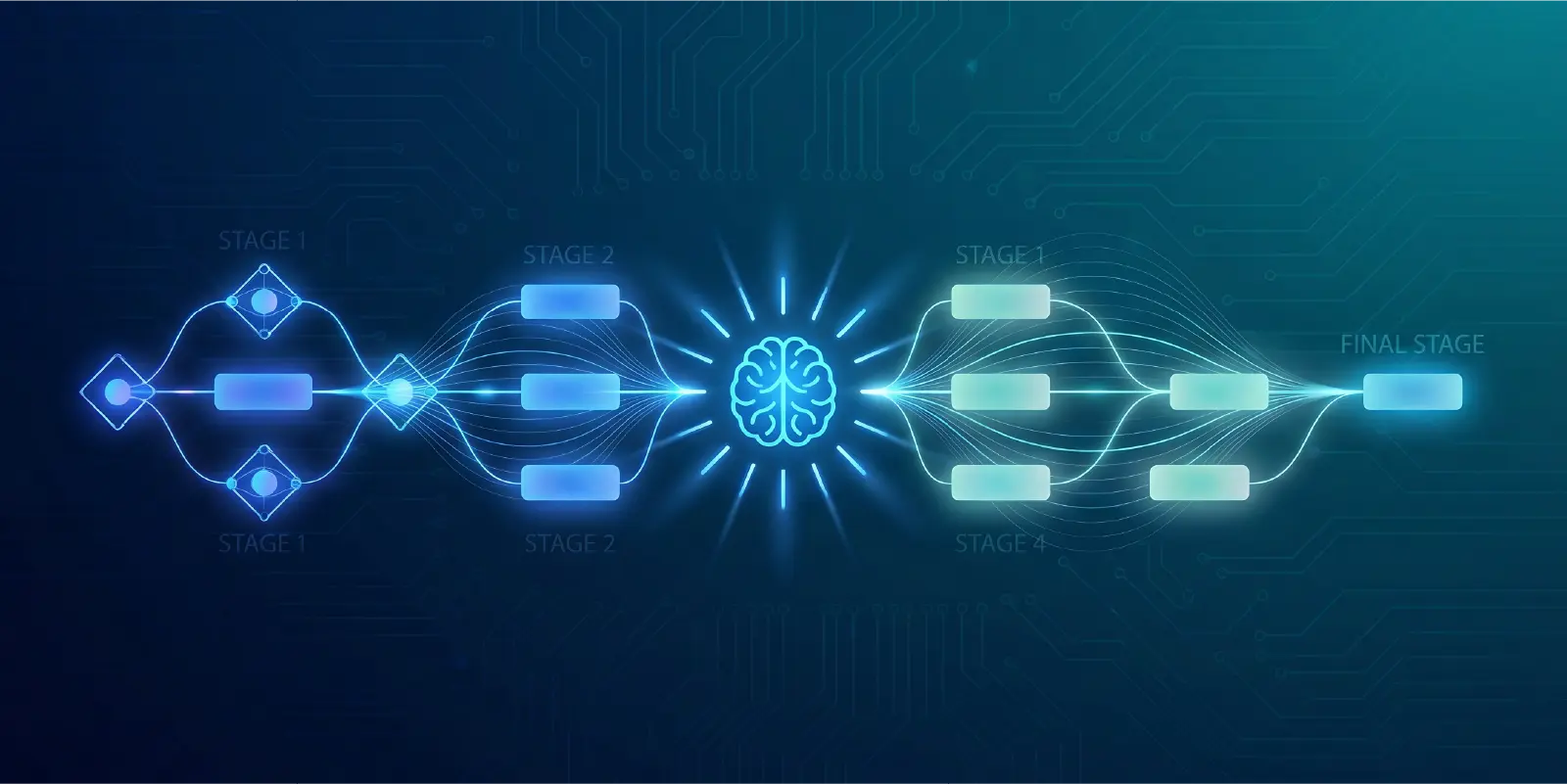
What we’ve found is that it’s not a tooling gap. It’s a staging gap. Most teams are stuck in the first phase of AI adoption and trying to skip to the third. Teams that get results move through three distinct stages, in order, and don’t rush the transitions.
Here’s what those stages actually look like from the inside, what breaks at each one, and how to tell when you’re ready to move on.
This is where every organisation starts, and where most are still sitting. Engineers get access to Copilot, Cursor, or Claude. They use it in their IDE. Some love it. Some ignore it. A few power users get dramatically faster at writing code, generating tests, and navigating unfamiliar codebases.
At Xceptor, this stage meant deploying GitHub Copilot across a 49-person engineering team, introducing AI-assisted UX prototyping, and using LLMs for research synthesis. Individual results were real: the design team hit 83% faster prototyping, well above their 50–60% target. Engineers who adopted the tools reported clear speed gains on daily tasks.
But delivery velocity didn’t move. Stories still queued the same way. Handoffs between product, dev, and QA were unchanged. Test cycles ran the same length. We were making individuals faster inside a system that was absorbing the speed.
Augment gives you faster engineers. It does not give you a faster team. That’s the trap.
What breaks here
Two things reliably go wrong in the Augment stage.
You’ve outgrown Augment when three things are true. Most of your team is using AI tools regularly (not just the early adopters). You can measure usage by engineer and by delivery phase, not just by licence count. And you’ve started to notice that the bottlenecks aren’t in code production anymore: they’re in requirements, reviews, testing, and handoffs between roles.
That’s the signal that individual speed has hit the ceiling and the system needs to change.
Automate is where the productivity paradox breaks. Instead of making individuals faster within unchanged workflows, you redesign the workflows so that AI handles repeatable execution steps and feeds output directly into the next phase.
This is the stage most organisations skip, and it’s the one that matters most.
At Xceptor, Automate looked like this: AI generating structured requirements from meeting transcripts, cutting story creation from 3 hours to under 1 hour while dropping rework from 30% to under 10%. AI writing test scripts from acceptance criteria using Playwright MCP, reducing scripting time by 75%, where one QA engineer now produces the output of four. An AI monitoring agent detecting and routing exceptions across 170+ SaaS instances, compressing resolution time from days to hours.
Notice what changed. Requirements generated by AI flowed directly into development. Test cases generated from those requirements caught defects earlier. Exception detection in production fed back into the next sprint’s backlog. The gains compounded because each phase’s output became the next phase’s input. That doesn’t happen in Augment. In Augment, the speed stays local.
Model quality is inconsistent, and you will have to swap tools mid-stream. At Xceptor, GPT-4 generated brittle test scripts. Copilot struggled with their custom Selenium setup. Switching test generation to Claude Opus and replacing Selenium with Playwright MCP got them to the 75% reduction. Committing to a single model or framework too early locks you into limitations you haven’t discovered yet.
Process is the bottleneck here. Automate doesn’t work if you bolt AI onto existing handoffs. You need to redesign how artefacts move between roles. At Xceptor, that meant mapping the full delivery lifecycle before touching any tool configuration: where stories stalled, where rework originated, which handoffs created delays. That mapping shaped the sequence. Tools came second.
DORA’s research backs this up directly. Teams working in loosely coupled architectures with fast feedback loops saw gains from AI. Teams constrained by tightly coupled systems and slow processes saw little or no benefit. Process is the bottleneck, not the model.
You’ve outgrown Automate when AI is reliably producing artefacts that humans review and approve rather than create from scratch. Stories, test suites, exception triage, deployment summaries. Your team’s role has shifted from writing to reviewing. You’re measuring time per delivery phase against baselines and seeing compression. And you’ve built enough trust in AI-generated output, through confidence thresholds, human gates, and incremental rollouts, that you can start thinking about agents that coordinate across phases rather than executing within a single one.
Agent is where most of the industry hype lives and where most of the failures will happen. Gartner predicts over 40% of agentic AI projects will fail by 2027. Stack Overflow’s 2025 survey found that 52% of developers either don’t use agents or stick to simpler tools, and 38% have no plans to adopt them.
Agent without Automate is a recipe for expensive chaos. If you haven’t already redesigned how artefacts flow between roles, giving an autonomous system the ability to generate and coordinate those artefacts will amplify every existing dysfunction. DORA’s central finding from 2025 applies here with force: AI amplifies what’s already there. Strong teams get stronger. Broken systems break faster.
We’re building this stage right now at Xceptor. A central orchestrator agent receives a feature request and coordinates specialised sub-agents for product, development, QA, and operations in parallel. PO agent generates requirements and acceptance criteria. Dev agent produces architecture docs, code, and PRs. QA agent builds test strategy, cases, and test data. DevOps agent handles security review, release summaries, and rollback plans. Nothing moves forward without human approval at every gate.
Our six-week MVP target: a complete product connector delivered from requirement to production-ready in under a day, with every artefact present and every output reviewed by a human.
Trust is the bottleneck, not capability. When we deployed Xceptor’s first production agent (the SaaS monitoring system across 170+ instances), false positive rates and routing reliability had to be solved before anyone would let it make real decisions. We deployed in read-only mode first, set confidence thresholds before allowing routing actions, required human sign-off on novel exception types, and rolled out instance by instance. That incremental trust-building is what most agent deployments skip.
Integration is the other wall. In the 2026 State of AI Agents report, 46% of respondents cited integration with existing systems as their primary challenge, not model intelligence. Your agents need to operate across your actual ticketing system, CI/CD pipeline, monitoring stack, and documentation platform. That’s plumbing work, and it’s where most ambitious agent projects stall.
Agent isn’t a destination you arrive at and stop. It’s an operating model you iterate on. You know it’s working when your team spends more time reviewing and steering than writing and building. Product owners direct agent output instead of drafting stories. Developers make architecture decisions instead of writing boilerplate. QA approves AI-generated suites instead of scripting tests manually. Every role shifts from doing to directing.
Staging matters more than speed. We’ve seen organisations try to jump from scattered Copilot usage to deploying agentic workflows and get burned. We’ve also seen teams spend a year over-optimising Augment without ever addressing the process bottlenecks that prevent team-level gains.
Three questions worth asking honestly:
This journey took Xceptor about a year. It required swapping tools mid-stream (Selenium to Playwright, GPT-4 to Claude Opus for test generation). It required accepting that adoption is a people problem before it’s a technology problem. It required measuring production impact rather than pilot activity. And it required changing how every role in the delivery lifecycle spends their time.
Nobody had to bet the budget on it. What mattered was doing things in order and being willing to fix what was broken at each stage before moving to the next one.
Organisations that will get the most from AI agents in 2026 and 2027 are the ones doing the unglamorous Automate work right now: redesigning handoffs, instrumenting measurement, building trust in AI-generated artefacts one phase at a time. That’s where the compounding starts.
For the full Xceptor case study with detailed metrics across all five delivery phases, read: How Xceptor Moved AI Out of the Pilot Phase and Into Every Stage of Delivery.



83% faster delivery. Under 10% rework. See exactly how Xceptor got there.