

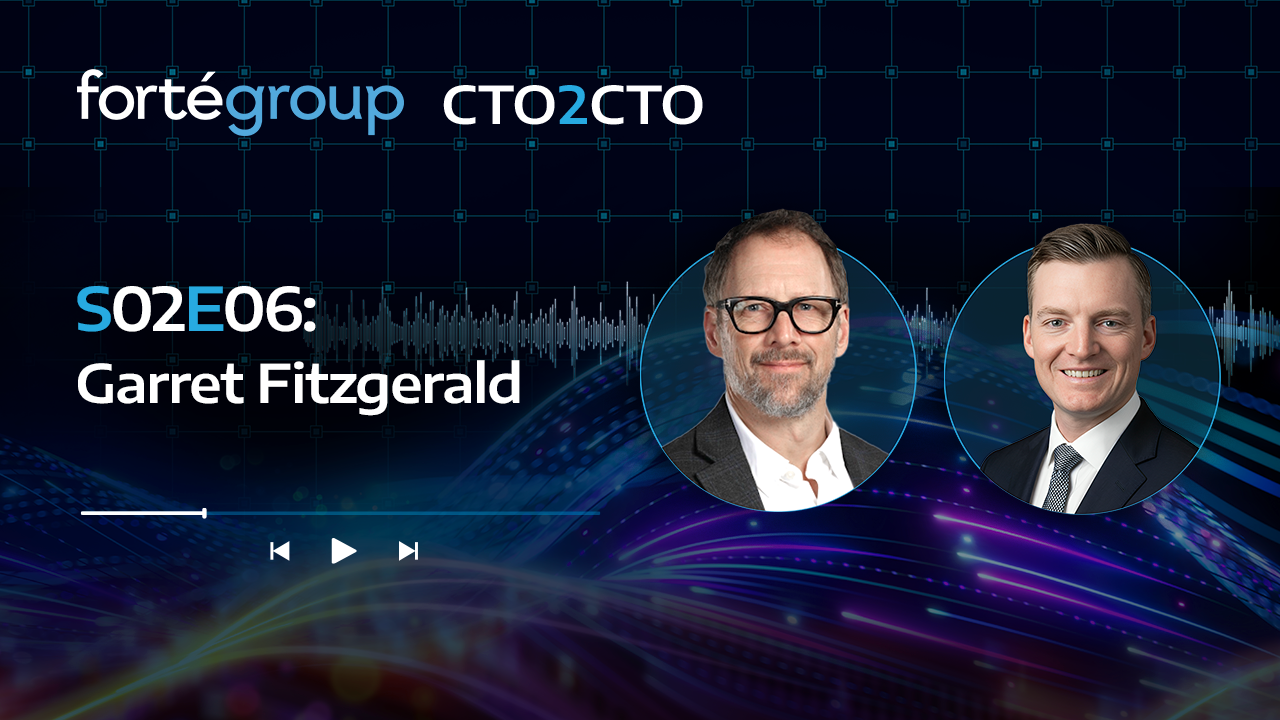

There's a lot of noise about AI transformation in enterprise. Less conversation about what happens when you're working with a 20-person family-owned manufacturing business that's never had a formal IT function.
That's the world Garrett Fitzgerald operates in.
As CTO at Invision Capital, a private equity firm investing in lower middle market companies, Garrett spent his time bringing enterprise-grade technology to businesses that have succeeded for decades without it. He is currently CIO at Salute, a data center services company, where he'll apply similar principles at larger scale.
In his conversation with Lucas Hendrich on CTO2CTO, Garrett shares a refreshingly practical perspective on AI adoption: what works, what doesn't, and why most people are still thinking about it wrong.
"The things that cost $100 million at GE 15 years ago can now be done at a 15-person manufacturing business,"Garrett explains.
His approach to value creation starts with the basics: Microsoft licensing, email, cloud storage, Azure services. Build the foundation before worrying about the bathroom faucets.
But here's what's changed: with AI tools, that foundation work is dramatically faster.
"Rather than finding a managed service provider, planning it out, spending two months executing, which isn't financially feasible for a 20-30 person company, I can come in with Claude and do it myself within two days."
The example: deploying Intune (Microsoft's endpoint management platform) for a 30-person company. Traditionally a multi-month project requiring external consultants. Now? Two days, done internally, at a fraction of the cost.
This isn't about replacing IT professionals. It's about making enterprise-grade capabilities accessible to companies that could never justify the traditional cost structure.
The most overrated aspect of AI, according to Garrett? The perception that it's a "magic black box" producing perfect outputs from generic inputs.
"I think there's this unrealistic expectation: it's God-like, you give generic input, get back exactly what you want, it's accurate. Then you get something that's hallucinated and people go, 'See? It doesn't work.'"
His alternative approach: treat AI agents like you would human teams.
"Throughout all of human history, not a single process ever looked like: generic input → magic box → perfect output. Reporters don't just write an article and instantly publish it to the Wall Street Journal. There's an editorial process."
The same applies to AI:
"When I'm writing a report and using AI heavily for research, it's really important to go through 5, 6, 7 fact-checking cycles using different models and tools. By the end, you get a pretty perfect report with reliable references."
One of Garrett's most counterintuitive insights: don't automatically replace rules-based systems with LLMs.
"A lot of people are moving away from rules-based to LLM-based in cases where they shouldn't be. You can actually use AI now to build much better, much faster rules-based controls."
The old mental model: rules engines are hard to build, require extensive human cognition and coding effort, and are difficult to maintain.
The new reality: use Claude Code (or similar tools) to design and build comprehensive rules-based approaches in one shot. Then use LLMs to monitor results, check for compliance changes, and update rules when appropriate.
"Rather than putting the LLM in there burning tokens every time, ask first: can I do this with rules? Then leverage AI to build those rules better and more reliably."
This is classic Garrett: pragmatic, cost-conscious, focused on what actually works rather than what sounds impressive.
Within a few years, Garrett predicts, it'll be normalized to have group chats where 60% of participants are agents.
But that requires solving a fundamental problem: identity.
"I think it's going to be important for us to distinguish between [co-work agents acting on behalf of humans] and [agents as independent entities]. People are doing things really well with open claw: they're creating distinct identities for each agent with its own accounts, its own Notion account, Gmail account, Slack account."
The key: transparency, not deception.
"I don't think it's a good idea to try and fake an agent as a person. People are going to want to make sure they know it's a legitimate person. We need a new or modified identity schema."
Practical problems remain: password managers, API key management systems, and security infrastructure aren't built for agents. They're built for humans.
"But I think there's probably a burgeoning product category we're gonna see in the next six months."
Companies like NVIDIA are already releasing enterprise wrappers for autonomous agents. Claude is pushing Cowork further. Within a year, Garrett expects enterprise-grade general-purpose agents to be widely available.
How should companies think about token spend and ROI?
Garrett separates AI investments into two distinct categories:
Category 1: LLM-based process automation
When you've built an agent-based workflow that runs repeatedly at volume, token spend vs. ROI matters immediately.
"If I'm going to get a $50,000 ROI, I don't want to spend $75,000 on tokens. Maybe I should use a manual process or process automation that doesn't use an LLM."
Category 2: Personal productivity and general-purpose agents
Here, focusing too narrowly on use-case-by-use-case ROI is a mistake.
"If you focus too much on that, you're missing the forest for the trees. In this world, you have to look over a longer time horizon because people need to learn and get new mental models."
Think of it like training investment. You won't see quarterly returns. But year-over-year: "Have I been able to hold flat at 10 resources but double my business?"
"There is a little bit of a leap of faith here. But you'll get the anecdotal and qualitative indicators over that period."
Garrett's career path, from GE's massive IT operations to lower middle market portfolio companies, gives him unique perspective on what scales and what doesn't.
At GE, he worked on projects measured in hundreds of millions of dollars. Now he's bringing similar capabilities to 15-person businesses.
The difference isn't technical sophistication. It's accessibility.
"Basic things like Microsoft licensing, email, cloud storage, Azure services; those things have never been cheaper and easier to implement than they are today."
His role as CIO at Salute, a data center services company, operates at larger scale but with similar principles: enable field services teams with better information, streamline sales processes, maintain startup nimbleness while building enterprise processes.
When asked about the difference between CTO and CIO roles, Garrett is blunt:
"I've been Chief Digital Officer, Chief Technology Officer, Chief Information Officer, a GM... the job's always been the same. It's just the context of where it sits in the business."
What matters more: the era of the "ivory tower" IT leader is over.
"You have to be both great leader and builder. Great leaders are going to be deeply involved in building."
He draws a parallel: "Imagine you're a CFO but you don't know what a VLOOKUP is because you've never used Excel. That's the parallel today to being a CIO or CTO and not getting to a very granular level of depth in using these new AI tools."
If you haven't done the prompting, the experimenting, the actual building, how can you lead a technology organization?
Beyond the mental model gap and the rules engine insight, Garrett believes one thing is massively underrated: the pace of improvement.
"The last three months, the capability is a hundred times improved over the last two years before that. I can't even explain it. The usability for the finance analyst, getting integrated into Excel, PowerPoint, on the desktop, with these agents—it's a step change."
Some people think: I'll wait until it's better, then I'll adopt.
Garrett's take: "By then you could be so far behind, because you've got to build those new mental models. Everyone's got to push now."
Garrett Fitzgerald doesn't traffic in hype. He's building AI capabilities in companies that have succeeded for decades without formal IT, where ROI has to be immediate and obvious, where complexity is a luxury no one can afford.
His insights cut through the noise:
If you're navigating AI adoption in organizations that aren't naturally "tech-first," Garrett's perspective offers a grounded, practical roadmap.
Listen to the full episode of CTO2CTO to hear more on agent identity, Six Sigma in the AI era, and why open claw strategies matter more than you think.


Let's talk about where you are today and where you want to go - our experts are ready to help you move forward.