How to Choose an AI Tech Stack: A Strategic Blueprint for Enterprise Scale
By 2026, building an AI solution without a clear architectural roadmap is more than a mistake—it’s a liability. We have moved past the "experimental era" of "spaghetti stacks" and unsustainable cloud spending. As we enter what many call the "Year of Truth" for AI, leadership has shifted from mere experimentation to constructing durable foundations.
Today, AI is the backbone of the digital economy. However, the stakes are high. While adoption is nearly universal, a persistent gap remains: nearly half of organizations still struggle to measure value. According toMIT Sloan research, the lack of unified reporting structures and data readiness is a primary reason AI projects are still at risk of abandonment.
The Evolution to the Agentic AI Stack
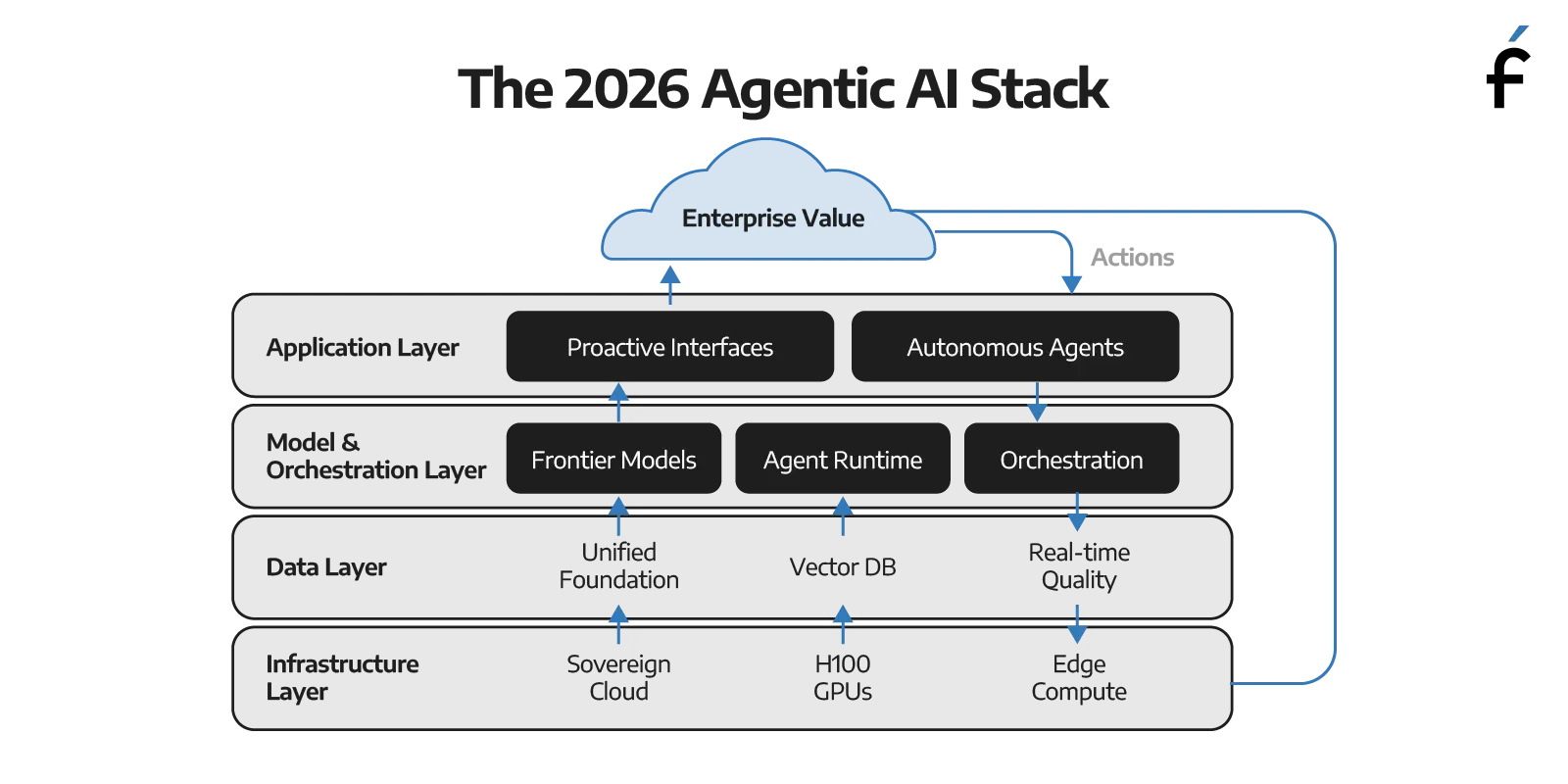
The traditional four-layer architecture has evolved. In 2026, we think in terms of an Agentic AI Stack. According to Gartner’s 2026 Strategic Technology Trends, the shift toward agentic experiences will reshape the market, with agents expected to generate significantly more data from physical environments than digital ones by the end of the decade.
1. The Infrastructure Layer: The Vertical Integration Shift
The foundation remains compute, but 2026 has seen a move toward "sovereign" and hybrid models.
Infrastructure Reckoning: Deloitte’s Tech Trends 2026 highlights an "Infrastructure Reckoning," where enterprises are moving away from binary cloud-vs-on-premise thinking toward a strategic three-tier hybrid architecture.
Specialized Hardware: The heavy lifting is now done by accelerators like the H100 and Hopper-class GPUs. Stanford’s HAI AI Index notes that while hardware performance continues to climb, energy efficiency and power availability have become the primary bottlenecks for scaling.
2. The Data Layer: Shared Meaning, Not Just Storage
The priority has shifted from collection to shared meaning.
Unified Foundations: Successful organizations are collapsing separate pipelines for analytics and AI, ensuring models and agents understand data through a common semantic layer.
Vector & Operational Integration: Platforms like MongoDB and Postgres (via pgvector) now handle lexical and vector search simultaneously, eliminating the "data silos" that plagued early RAG (Retrieval-Augmented Generation) projects.
3. The Model Layer: The Era of "Thinking" Models
The 2026 model layer is dominated by "unified systems" that intelligently route prompts based on complexity.
← Scroll to see full table →
Model Category
Key 2026 Contenders
Defining Feature
Frontier Models
GPT-5.4, Gemini 3.1 Pro
Intelligent prompt routing and multimodal reasoning.
Agentic Specialists
Claude Opus 4.6
Optimized for autonomous coding and software engineering.
Open-Weight Disruptors
Llama 4 Maverick
Industry-leading context windows (up to 10M tokens).
4. The Application Layer: Proactive Interfaces
We have transitioned from "assistive AI" (waiting for prompts) to "agentic AI" (pursuing goals). Gartner predicts that by 2026, 40% of enterprise applications will have embedded AI agents, transforming monolithic backbones into modular, continuously learning ecosystems.
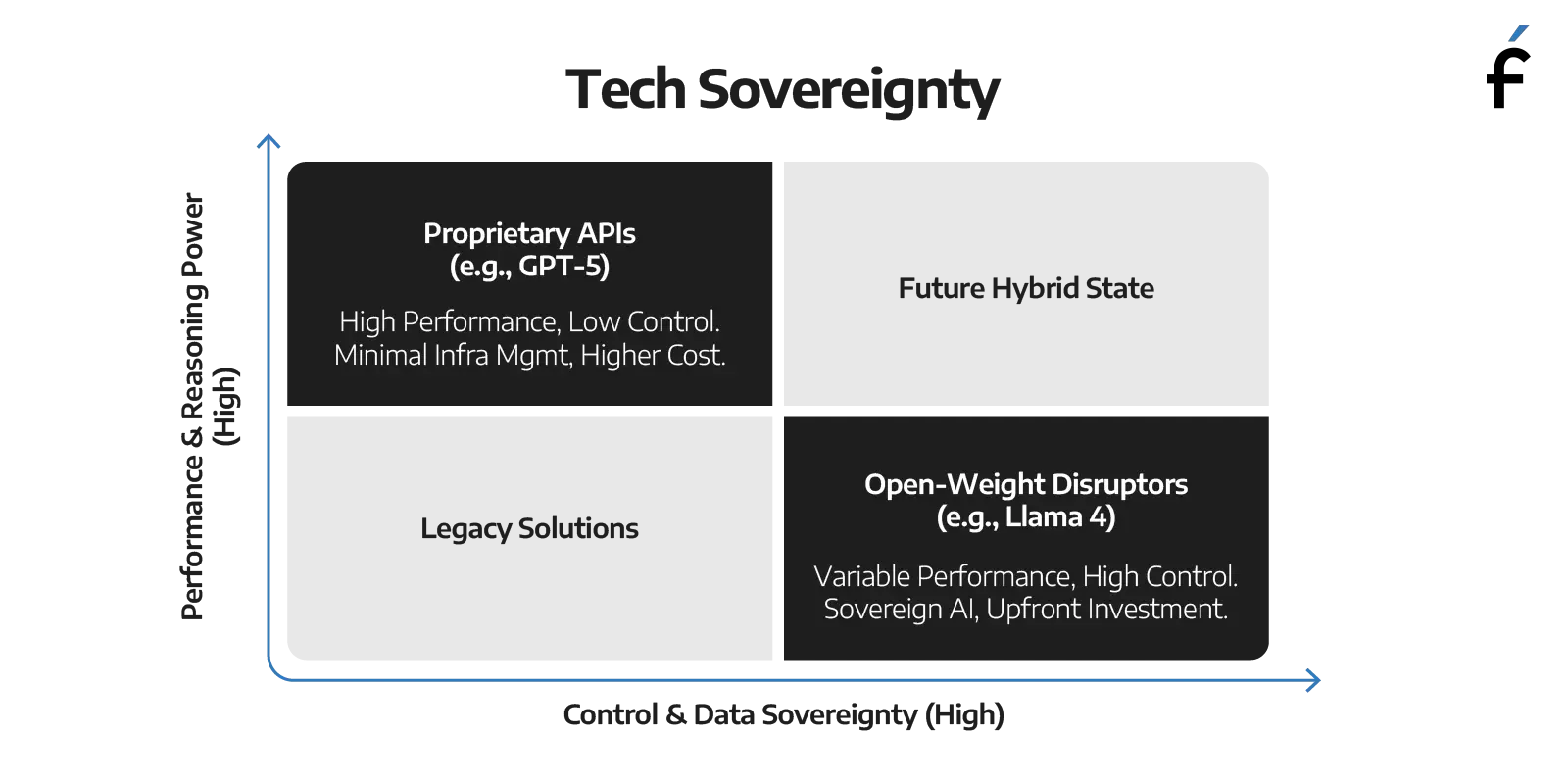
Strategic Decision Matrix: Proprietary vs. Open-Weight
Choosing your stack is now a "tech sovereignty" decision rather than just a budget line item.
Frontier Proprietary APIs: These remain the "titans of reasoning." They offer the highest out-of-the-box performance for high-stakes analysis. However, organizations must weigh this against potential "fair use" training on their data and a lack of transparency in training weights.
Open-Weight Disruptors:Stanford HAI reports that the performance gap between closed and open-weight models has shrunk significantly, making "sovereign AI" (self-hosting) a viable reality for enterprises requiring total data control.
Solving the "AI Power Problem"
Cloud-only strategies are becoming financially unsustainable for high-utilization workloads.
The 6-Hour Rule: Deloitte suggests that if an AI workload runs for more than six hours per day, it is typically more cost-effective to own the hardware.
Cost Efficiency: On-premise infrastructure can be 40–60% cheaper than cloud over a 3-year period when factoring in constant inference at 70% utilization, allowing for better CapEx amortization.
You wouldn’t ship code without a spec; you shouldn’t deploy an agent without a governance model.
Traceability: Ensuring every autonomous decision is auditable and transparent.
Modular Guardrails:MIT Sloan warns that "ongoing hallucinations and prompt injection" remain the biggest risks to agentic adoption, requiring "human-in-the-loop" oversight to maintain safety and alignment.
Implementation Roadmap: Constructing the Foundation
Agentify High-Impact Workflows: Start with 2-3 end-to-end processes (e.g., IT Ops or Sales) where autonomy unlocks immediate value.
Modernize Data Architecture: Move to real-time, continuous quality management to provide agents with a high-fidelity context.
Define Human-Agent Collaboration: Establish clear levels of autonomy—determining what stays under human control and where AI is permitted to act independently.
Conclusion: Success in 2026 requires a balanced hybrid infrastructure that respects data sovereignty and solves the "power problem." Whether you rely on the frontier reasoning of GPT-5 or the massive context of Llama 4, your tech stack is now the engine of your organizational resilience.
With over a decade's enterprise marketing experience across B2B and software engineering environments, including Deloitte Ukraine, Kateryna specialises in integrated campaign strategy, content, and competitive intelligence, translating complex technical capabilities into compelling narratives that drive pipeline growth and measurable business outcomes.