


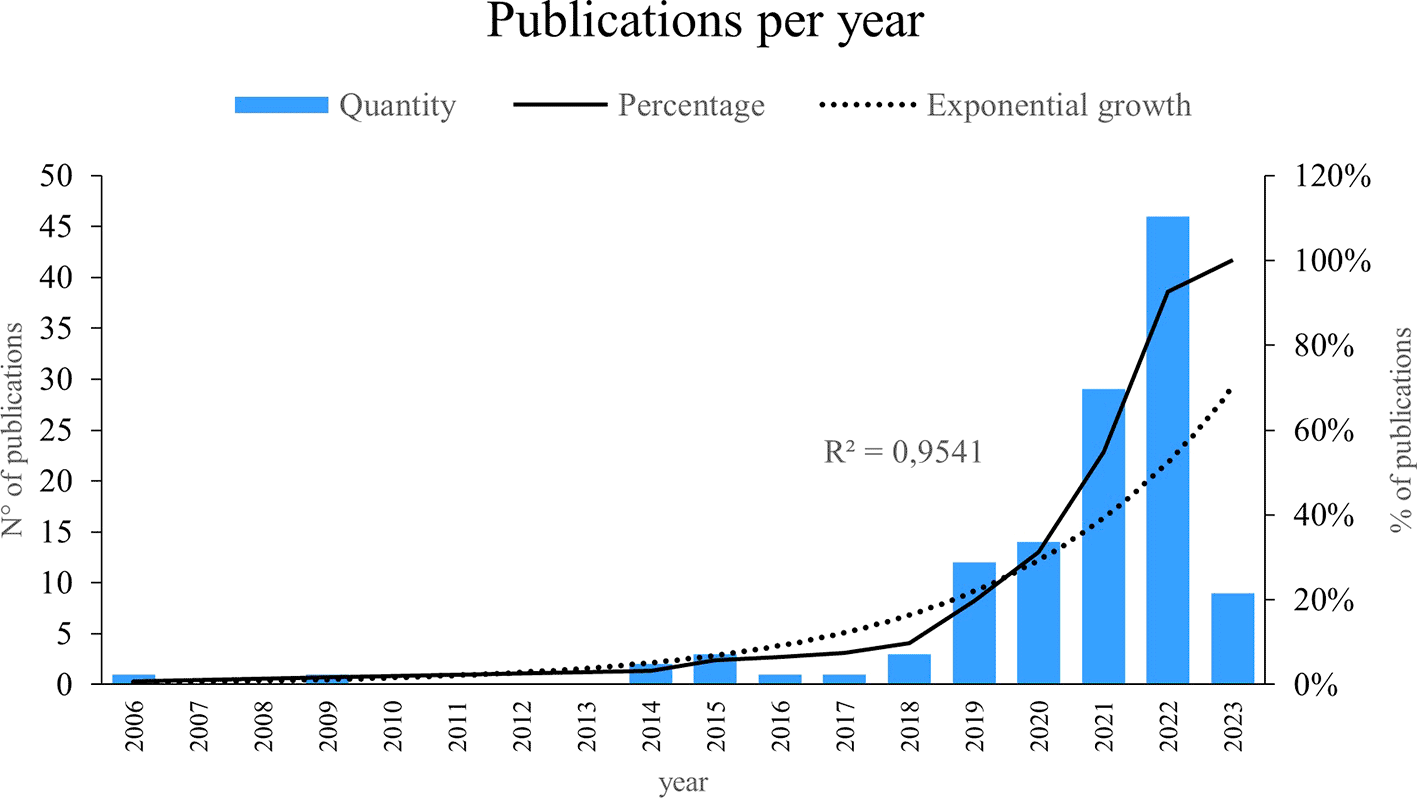
The academic community recognised this shift early. A peer-reviewed study published in F1000Research in 2025, which analysed 122 research papers on ML in marketing published between 2006 and 2023, found that academic interest in the field has grown exponentially, with peak activity in 2019 through 2022. The dominant research theme across that period shifted from experimental technique to core digital marketing infrastructure. In other words: what was fringe is now foundational.
The practitioner data confirms the same direction. According to Salesforce's Tenth State of Marketing report, 75% of marketing organisations are already using at least one form of AI, and those that have adopted it are seeing a 20% increase in marketing ROI. HubSpot's 2025 State of Marketing report found 92% of marketers say AI has already impacted their role. IDC projects a 40% potential increase in enterprise marketing productivity by 2029 from generative AI adoption alone.
This article covers what machine learning in marketing actually means, the six use cases that deliver the most measurable commercial value, real-world examples with hard outcomes, the implementation challenges that derail enterprise teams, and a practical framework for getting started.
It's the application of algorithms that learn from data: customer behaviour, transaction history, engagement signals, demographic attributes, to improve marketing decisions automatically and continuously, without being manually reprogrammed after each update.
The distinction from traditional marketing technology matters. A rules-based system does exactly what it is told: if a customer abandons a cart, send a reminder email. A machine learning system observes what works across millions of cart abandonment scenarios, identifies which customers respond to which types of messages at which times through which channels, and adjusts its behaviour accordingly. The rules emerge from the data rather than being written in advance.
Three types of machine learning are used in marketing contexts:
Supervised learning trains on labelled historical data: past customer transactions, engagement records, churn events, to predict future outcomes. If a model is trained on the attributes of customers who churned versus those who stayed, it can identify which current customers show similar early-warning patterns. Churn prediction, lead scoring, and customer lifetime value modelling are all supervised learning applications.
Unsupervised learning identifies structure in unlabelled data without a predefined outcome. It finds clusters, patterns, and associations that humans wouldn't see in a dataset of millions of records. Customer segmentation - grouping customers by behavioural similarity rather than manually defined demographic categories, is the primary marketing application.
Reinforcement learning learns through experimentation. It takes an action, receives a reward signal based on the outcome, and adjusts future decisions to maximise that reward. Real-time ad bidding, dynamic pricing, and adaptive content optimisation are reinforcement learning applications.
The same F1000Research study tracks how research themes evolved over that period: in 2006 the field was dominated by narrow algorithmic techniques; by 2020 Big Data and Neural Networks had taken over; by 2021–2023 Digital Marketing itself was the leading theme. The research agenda followed where practitioners were already heading.
According to the Marketing AI Institute, 80% of organisations adopting AI in marketing are doing so specifically to reduce time spent on repetitive tasks. For enterprise marketing leaders, the relevant question is no longer whether to adopt ML - it is which use cases to prioritise, in what order, and with what infrastructure in place.
Segmentation is the practice of grouping customers by shared characteristics to deliver more relevant marketing. Machine learning transforms this from a periodic, manually defined exercise into a continuous, self-updating process.
Traditional segmentation creates static groups: age 25–34, located in the US, purchased in the last 90 days. ML segmentation discovers clusters based on behavioural similarity across hundreds of variables simultaneously, finding groups that no marketing analyst would have defined in advance. More importantly, it keeps those segments current: as customers change their behaviour, ML models update their classification in real time.
The commercial impact of getting targeting right is substantial. McKinsey research shows that effective personalisation can reduce customer acquisition costs by up to 50%, lift revenues by 5 to 15%, and increase marketing ROI by 10 to 30%. Machine learning is the mechanism that makes personalisation at enterprise scale operationally feasible.
A concrete example: Walgreens, the second-largest US pharmacy chain, partnered with Clinch's ML-powered ad personalisation platform to target customers during allergy season. Rather than broadcasting to a broad audience, the system used customer location data, real-time weather information, and individual purchase history to deliver dynamic ad variants precisely when local pollen counts made allergy products relevant. The campaign generated a 276% increase in click-through rate and a 64% reduction in cost-per-click across 160 personalised ad variations.
For enterprise marketing teams considering adoption: the entry point is identifying one high-value segment where better targeting would measurably improve conversion or reduce acquisition cost. The data you need already exists in your CRM and analytics stack. The ML infrastructure extracts the signal from it.
Recommendation systems are among the most commercially proven ML applications for marketing departments. Popularised by Amazon's product recommendations and Netflix's content suggestions, the underlying logic is now applied across enterprise B2B and D2C, from personalised content delivery and account-based marketing to dynamic email content and website personalisation.
Three recommendation approaches are used in practice. Collaborative filtering suggests products or content that customers with similar behaviour patterns have engaged with - the "customers like you also bought" mechanism. Content-based filtering recommends items similar to those a specific customer has already engaged with, based on attributes of the content itself. Hybrid systems combine both approaches to address the limitations of each - collaborative filtering struggles with new customers (the "cold start" problem), while content-based filtering can over-personalise and miss discovery.
The frontier of recommendation engine application is expanding. Myntra, the Indian fashion e-commerce platform, has moved beyond product recommendation into using ML to inform product design - analysing trend data from fast-moving sales patterns to guide the creation of new items before demand peaks. Where recommendation engines once served existing catalogues, ML is now shaping what gets created in the first place.
For enterprise B2B marketing teams, the immediate application is content personalisation: serving different articles, case studies, and solution pages to visitors based on their industry, role, and engagement history: account-based marketing at a scale that manual segmentation cannot support.
Predictive analytics is where machine learning delivers its clearest commercial case for enterprise marketing teams. Two applications stand out.
Customer lifetime value (CLV) prediction uses ML to forecast the total revenue each customer relationship will generate. Rather than treating all customers equivalently, CLV models allow marketing and sales teams to allocate effort proportional to value, focusing retention investment on high-value accounts and acquisition spend on prospects with the strongest predicted value profile.
Churn prediction identifies customers whose behavioural signals indicate they are approaching disengagement, before they leave. ML models detect early warning patterns that human analysts cannot reliably spot at scale: declining login frequency, reduced feature usage, changes in support ticket patterns, slowing purchase velocity. Once flagged, at-risk customers can be targeted with retention interventions before the relationship deteriorates.
The practical value of causal ML; not just predicting what will happen, but understanding what interventions actually cause outcomes, is demonstrated in a study by Langen and Huber (2023), which applied causal ML to evaluate a retailer's coupon campaign. The analysis found that only 2 of 5 coupon categories had statistically significant effects on sales, and that targeting effectiveness varied substantially by customer segment: drugstore coupons were most effective for customers with high prior purchase history, while other food coupons performed best with low-prior-purchase customers. A purely predictive model would have missed this distinction. The causal approach identified not just who was likely to respond, but which intervention would actually cause the response.
Martech in its traditional form relies on fixed logic: trigger a sequence of emails when a customer takes a defined action, pause it when they take another. ML-powered automation replaces fixed logic with adaptive logic: the system learns from what works and adjusts message, timing, channel, and frequency dynamically.
Natural language processing (NLP), a subset of machine learning, is the enabling technology for conversational AI applications in marketing: chatbots, virtual assistants, and AI-generated content. Modern CRM platforms; Salesforce Agentforce and Microsoft Dynamics 365, now include ML-powered automation and NLP capabilities natively, making this accessible to enterprise marketing teams without custom ML development.
The commercial evidence for ML-driven content personalisation in high-consideration contexts is particularly strong. Vanguard's institutional division worked with Persado's NLP platform to personalise marketing messages for retirement plan sponsors, a highly regulated context where the company could only reach potential clients through limited channels including LinkedIn. Persado's ML analysed the tone and emotional register of Vanguard's content, tracked consumer response patterns, built individual emotional profiles, and generated hyper-personalised copy calibrated to each client's decision-making style. The result was a 15% increase in conversion rate in a regulated financial services context where marginal gains are unusually hard to achieve.
Machine learning changes content marketing from a publish-and-observe discipline into a continuously optimising one. ML-powered content tools analyse competitor content, search engine results, and live user behaviour signals to identify what topics are gaining traction, which keyword patterns are improving rankings, and how page structure affects engagement.
The most advanced applications operate in real time. Rather than running a quarterly content audit, ML systems monitor how visitors interact with content: time on page, scroll depth, click patterns, exit behaviour, and surface recommendations for structural and topical improvements based on live signal. This extends to dynamic page optimisation: adapting layout, topic emphasis, and calls to action based on visitor attributes and behaviour in the session.
Research published in PMC examining e-commerce clickstream data found that time spent reading product information, combined with bounce rate, exit rate, and customer type, are the most statistically significant ML-identifiable predictors of purchase decisions. The implication for content teams is direct: the ML signal that predicts conversion is in the quality and relevance of content, not just in the promotional mechanics around it.
Marketing analytics ML addresses one of the most persistent and expensive problems in enterprise marketing: understanding which activities actually drive revenue.
Multi-touch attribution - assessing the contribution of each channel, touchpoint, and piece of content across the buyer journey, is analytically intractable at enterprise scale without ML. The number of possible customer paths through modern marketing stacks is too large for any rules-based attribution model to handle accurately. ML models can process the full breadth of customer journey data and identify which sequences of interactions most reliably precede conversion, which channels contribute to awareness versus decision, and where budget reallocation would improve ROI.
Alongside attribution, sentiment analysis has become a practical enterprise ML application. NLP models process social media content, review platforms, and customer feedback at scale - classifying sentiment as positive, negative, or neutral, tracking shifts over time, and flagging emerging reputation signals before they become visible in sales data.
A third application is brand equity analysis. Xu et al. (2022) demonstrated that ML applied to customer mix data can identify the specific factors that contribute to brand equity, allowing marketing teams to understand not just what customers think, but which marketing activities are actually building or eroding the brand's long-term value position.
Arbital Health leveraged machine learning to reverse engineer the negotiated rates between healthcare payers and providers by analysing real claims data. Given the complexity involved; thousands of procedure types, numerous independently negotiating medical groups, and varying locations, the team developed sophisticated models to navigate the many variables determining actual prices. A standout technique was quintile regression, used to classify and predict price ranges for imaging procedures. By late 2014, the growing volume of data enabled the business team to begin building predictive models for patient conditions, marking a significant evolution in how the company used data to inform its operations and marketing strategy:
Luxury Hawaiian resort Turtle Bay partnered with Salesforce to deploy ML-driven personalisation across its guest experience marketing. Using Salesforce Data Cloud to consolidate guest booking history and on-property interaction data, and Marketing Cloud Personalization to generate recommendations, the resort served each website visitor with personalised activity suggestions based on their preferences and behaviour patterns. A visitor booking a specific activity would immediately be shown contextually relevant upsell content (a snorkelling session, a guided excursion), rather than generic resort promotion. The outcome: a 40% increase in customer engagement.
Walgreens deployed Clinch's ML-powered platform to serve context-triggered allergy medication advertising. The system combined user location data, real-time local weather and pollen count data, and individual purchase history to determine when each customer was most likely to need allergy products, and served dynamic ad variants calibrated to that moment. The campaign generated 276% higher click-through rates and a 64% reduction in cost-per-click across 160 distinct ad variations.
Vanguard's institutional investment division used Persado's ML platform to personalise marketing messages in a highly regulated context where direct outreach channels are limited. The platform used NLP to analyse brand tone, tracked individual emotional response patterns to different message framings, and generated personalised copy for each prospect. The result was a 15% increase in conversion rate, significant in an institutional financial services context where sales cycles are long and regulatory constraints on messaging are significant.
Taiwan's largest media outlet CommonWealth implemented Appier's ML platform to increase customer engagement and advertising effectiveness across its digital properties. The system analysed real-time visitor behaviour to build accurate reader profiles, then combined those profiles with CRM data to serve dynamically personalised advertisements. For a single ad campaign, Appier's ML increased click-through rate sixfold and reduced bounce rate by 30% through keyword optimisation alone.
The commercial case for ML in marketing rests on four categories of value, each now evidenced at enterprise scale.
Cost reduction and efficiency is the most immediate and measurable benefit. The Marketing AI Institute reports that 80% of organisations adopting AI in marketing are doing so specifically to reduce time on repetitive tasks. ML automation handles campaign scheduling, audience segmentation, bid optimisation, and performance reporting, releasing marketing teams to focus on strategy, creative direction, and relationship management.
Personalisation at scale is the value that rules-based automation cannot deliver. Manually designed personalisation breaks down beyond a few audience segments and a handful of content variants. ML personalisation operates at the individual level across audiences of millions. McKinsey's research links effective personalisation to up to 50% reductions in acquisition cost, 5–15% revenue increases, and 10–30% improvements in marketing ROI. ML is the only mechanism that makes that level of personalisation operationally viable for enterprise organisations.
Predictive advantage represents the shift from reactive to anticipatory marketing. Traditional analytics answers the question "what happened?" Predictive ML answers "what will happen, and what should we do about it?" Churn prediction and customer lifetime value modelling are the two applications where this shift has the clearest revenue impact. Salesforce's 2026 State of Marketing report finds that teams using AI are already seeing a 20% increase in marketing ROI, and 82% of marketers who use or plan to use AI agents expect moderate or major improvements in ROI.
Improved attribution and decision-making addresses the chronic enterprise marketing problem of understanding which activities actually drive revenue. ML attribution models replace the blunt instruments of last-click and first-touch attribution with multi-touch models that accurately account for the contribution of every channel and touchpoint across complex buyer journeys.
Despite the commercial evidence, ML adoption in enterprise marketing fails more often than it succeeds, and almost always for the same reasons. Understanding the failure modes is as important as understanding the use cases.
Academic literature on ML in marketing has increasingly foregrounded the distinction between personalisation and manipulation. Personalisation uses data to deliver experiences that genuinely serve customer needs: a relevant product recommendation, a timely reminder, a message that acknowledges where someone is in their decision process. Manipulation uses data to exploit psychological vulnerabilities: artificial urgency, targeted appeals to financial insecurity, advertising to children in ways that bypass parental oversight.
The line between them is not always sharp, and the same ML system can sit on either side depending on how it is deployed. Enterprise marketing teams adopting ML have an obligation to define that line explicitly in their programme governance, not because regulators require it (though they increasingly do), but because it is the foundation of sustainable customer relationships.
For most enterprise marketing leaders, the path to ML adoption is clearer than it appears. The barrier is not the technology; it is sequencing and data readiness.
Step 1: Audit your data infrastructure. ML cannot perform without clean, accessible, consolidated data. Before evaluating vendors or scoping use cases, assess whether your CRM data is complete and current, your analytics stack is integrated, and your data governance policies are in place. If your marketing team cannot answer basic attribution questions with your current data, ML will amplify those gaps rather than close them.
Step 2: Start with one high-value use case. Churn prediction and customer lifetime value modelling are the highest ROI entry points for most enterprise teams. Both use data you already have: purchase history, engagement signals, support interactions, and produce outcomes that are directly measurable in revenue terms.
Step 3: Decide to build, buy, or partner. Most enterprise marketing teams begin with platform-native ML: Salesforce Agentforce, HubSpot AI, Adobe Sensei, Microsoft Dynamics 365. Custom ML development is appropriate when your competitive differentiation depends on capabilities that no off-the-shelf platform provides, when your data environment is too complex or proprietary for standard tools, or when the scale and specificity of your use case exceeds platform constraints. Custom builds require a delivery partner with both ML engineering capability and marketing domain expertise; precisely the collaboration gap identified in the research literature.
Step 4: Measure causality, not correlation. The most common ML implementation failure is optimising for the wrong signal. The Langen and Huber (2023) coupon campaign study demonstrates the difference: causal ML identified that only 2 of 5 coupon types actually caused improvements in sales, and that the right coupon for a customer depended on their prior purchase history. Without causal analysis, three of five coupon programmes would have continued to receive budget despite having no measurable effect.
Forte Group works with enterprise marketing and technology teams to scope, build, and integrate custom ML solutions - from initial data infrastructure assessment through to production deployment and ongoing model governance. If you are assessing the feasibility of ML for your marketing function, our ML consulting team can help you identify the right use case, audit your data readiness, and design the build.
What is the difference between AI and machine learning in marketing? AI is the broader concept; any system that mimics human intelligence, including reasoning, language understanding, and learning. Machine learning is a specific subset of AI in which systems improve their performance by learning from data, without being explicitly reprogrammed. In marketing, most practical AI applications: recommendation engines, churn prediction, personalised content, are machine learning applications. "AI in marketing" is often used loosely to describe the same capabilities.
What is the most common use of machine learning in marketing? Customer segmentation and targeting is the most widely adopted ML application in enterprise marketing, followed by personalisation and recommendation engines. These are the two use cases with the longest deployment history and the most mature platform support. Churn prediction and CLV modelling are the fastest-growing applications as enterprise teams move from awareness to active adoption of predictive analytics.
How does machine learning improve customer segmentation? Traditional segmentation creates static customer groups based on manually defined criteria: demographics, purchase frequency, geography. ML segmentation discovers groups based on behavioural similarity across hundreds of variables simultaneously, identifies patterns no analyst would define manually, and updates segment membership continuously as customer behaviour changes. The practical result is more precise targeting, higher conversion rates, and reduced wasted spend on audiences unlikely to respond.
What is predictive analytics in marketing? Predictive analytics in marketing is the use of ML models trained on historical customer data to forecast future behaviour. The two primary applications are churn prediction, identifying customers showing early behavioural signals of disengagement and customer lifetime value prediction: forecasting the total revenue value of each customer relationship. Both enable marketing and sales teams to act on risk and opportunity signals weeks or months in advance, rather than responding after the fact.
Is machine learning in marketing only for large enterprises? The research literature on ML in marketing has identified SME applicability as a documented gap: most studies to date have focused on large enterprise contexts. In practice, platform-native ML capabilities - available through Salesforce, HubSpot, Mailchimp, and similar tools, have made basic ML applications accessible to mid-market businesses without the data scale or technical infrastructure of large enterprises. Custom ML development remains most viable for organisations with sufficient data volume and a competitive case for proprietary models.
What data do you need to implement machine learning in marketing? The minimum viable data infrastructure for most ML marketing use cases is: a CRM with reasonably complete and current customer records; web analytics data linked to customer identities where possible; transaction or engagement history going back at least 12–24 months; and a consistent schema across data sources. The quality of your data matters more than its volume. A model trained on clean, well-structured data from 50,000 customers will outperform one trained on inconsistent data from 500,000.
How long does it take to implement a machine learning solution for marketing? Timeline varies significantly by use case and infrastructure readiness. Platform-native ML features can be activated in days to weeks. Custom ML model development, including data infrastructure assessment, feature engineering, model training and validation, integration, and deployment, typically takes three to six months for an initial production-ready model. The most common cause of timeline overrun is data readiness issues discovered after the project has started. A data audit before scoping prevents the majority of those delays.
What is the difference between personalisation and manipulation in ML marketing? Personalisation uses customer data to deliver genuinely relevant experiences - a product recommendation aligned to purchase history, a message timed to a customer's demonstrated readiness to buy, content matched to a visitor's industry and role. Manipulation uses the same data to exploit psychological vulnerabilities: artificial scarcity, targeting financially stressed customers with high-interest credit products, advertising to children in ways that bypass rational decision-making. The distinction matters both ethically and commercially: manipulative ML marketing erodes the trust that personalised marketing builds. Enterprise ML programmes should define the line explicitly in their governance frameworks before deployment.
Machine learning in marketing is no longer an emerging capability, it is the current standard for enterprise marketing teams competing on personalisation, attribution, and efficiency. The evidence is concrete: 276% CTR increases from ML-targeted campaigns, 40% engagement gains from ML-driven personalisation, 15% conversion improvements from NLP-powered message optimisation.
The commercial case is reinforced by one figure worth highlighting separately: the 4.4x conversion premium of AI-referred web traffic, documented by Semrush's 2025 research across Google AI Overviews, ChatGPT, Claude, and Perplexity. Visitors who arrive via an AI-generated response have already been pre-qualified: they understand the category, have compared options, and are closer to a decision. For companies selling complex, high-consideration services, that is the most commercially significant number in the current digital marketing landscape.
The barrier to ML adoption is not the technology. It is data readiness, implementation sequencing, and bridging the gap between marketing expertise and ML engineering, the specific challenge the research literature identifies as the most underaddressed in the field. Those are solvable problems with the right partner.



83% faster delivery. Under 10% rework. See exactly how Xceptor got there.