


The agents are already in your stack. However, most engineering leaders cannot answer three basic questions about them: who reviews their performance, who has the authority to update what they do, and how a local win gets captured and scaled. The governance gap is now the single biggest operational risk in enterprise AI.
For the last two years, every conversation about AI in the enterprise has been about capability. Can the model do the thing? Is it accurate enough? Is it fast enough? Those questions have been settled. The 2026 Stanford AI Index shows AI agent performance on OSWorld jumping from 12% to roughly 66% task success in a single year. Capability is no longer the bottleneck.
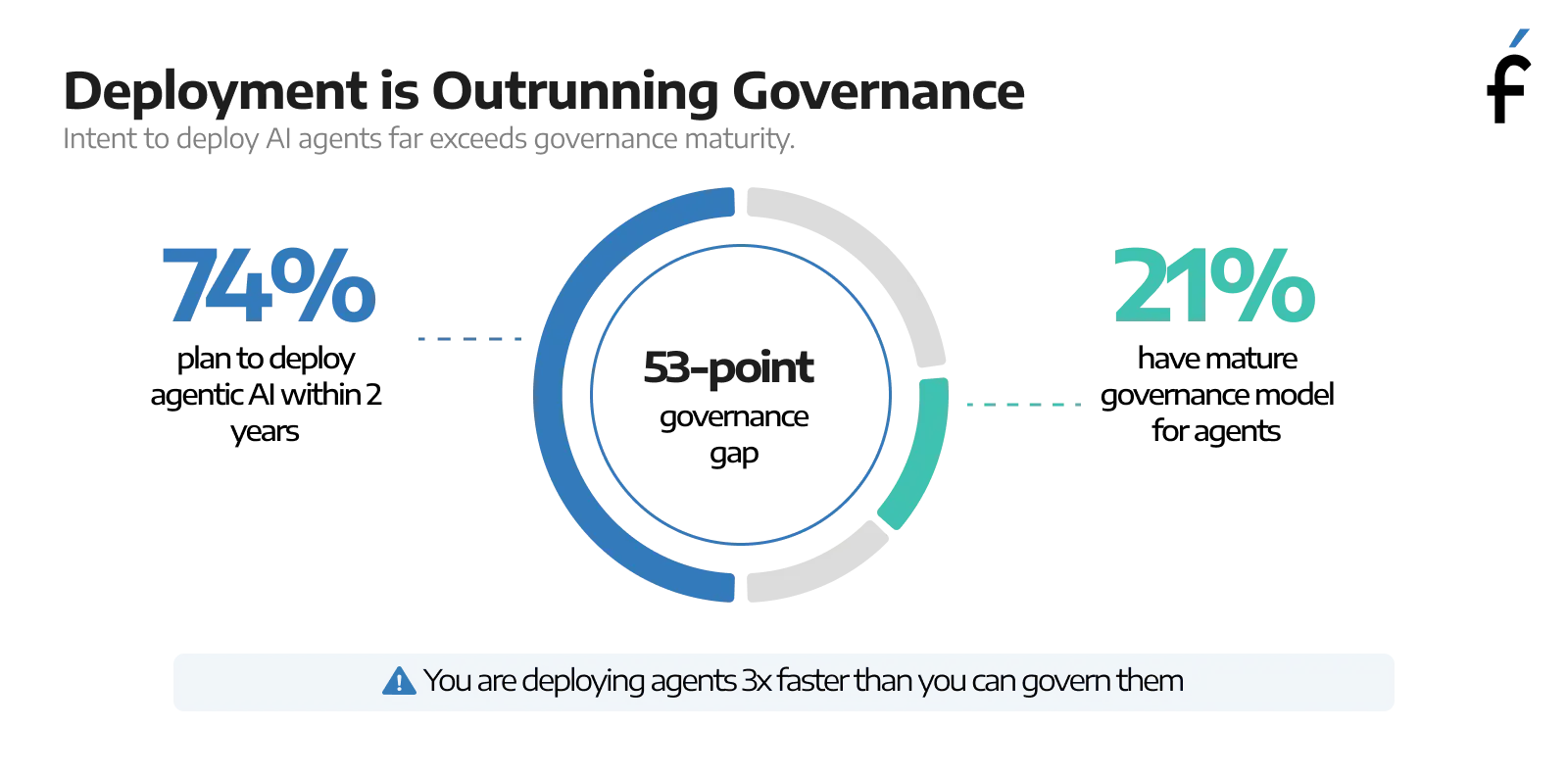
The bottleneck is governance. According to Deloitte's 2026 State of AI in the Enterprise, 74% of organizations plan to deploy agentic AI within the next two years. Only 21% report having a mature governance model for autonomous agents. That is a 53-point gap between intent and capability. Microsoft's 2026 Work Trend Index makes it worse: active agents across Microsoft 365 grew 15x year-on-year, rising to 18x in large enterprises.
If you are running engineering at scale today, you are deploying agents three times faster than you can govern them. That math does not end well.
The standard response to a governance gap is to write a policy document: Acceptable use policies, AI ethics frameworks, responsible AI principles. There is now an entire consulting industry built on producing these documents, most of which will sit in SharePoint and never touch a production system.
This is the wrong layer.
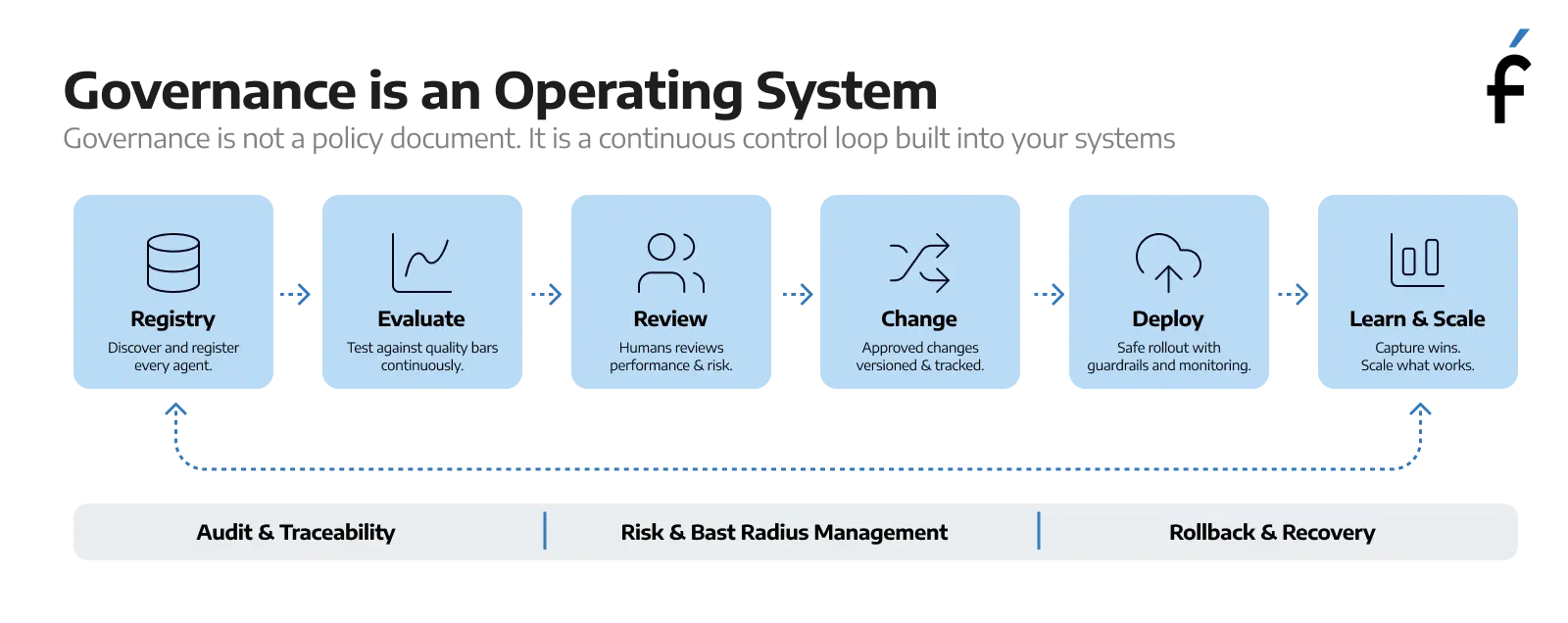
Policies tell humans what they should do. Governance tells systems what they are allowed to do, who reviews the outcomes, and what happens when something breaks. The first lives in a Word file. The second lives in your identity provider, your audit logs, your CI/CD pipeline, and your incident response process. Confusing the two is the most expensive mistake engineering leaders are making in 2026.
The brutal reality: if your agent governance lives in a PDF, you do not have agent governance. You have a compliance artifact.
Lee Barnes, our Chief Quality Officer, recently wrote about AI agent readiness and made the operational case: before agents take off, they need a pre-flight checklist. Identity. Scope. Recovery. That work is necessary,but it is not sufficient. Pre-flight gets one agent off the ground safely. Governance is what lets you run a fleet.
Microsoft's 2026 Work Trend Index distilled the governance problem to three questions that every "Frontier Firm" must answer. They are deceptively simple, and most engineering organizations cannot answer them today:
Not who wrote the agent. Not who deployed it. Who is accountable for whether it continues to do what it was designed to do, six months after launch, when the underlying model has been swapped, the prompts have drifted, and the input distribution has changed?
If the answer is "the person who built it," your governance is already broken. The person who builds something is the worst person to review it.
Agents are not static code. Their behavior depends on the model version, the prompt, the tools they have access to, the knowledge base they retrieve from, and the workflow they execute. Each of those can be changed independently. Each change can break the others.
If you cannot point to a single named role with the authority and accountability to make those changes, then in practice everybody can change them and nobody is responsible when they do.
This is the question almost nobody answers. An engineering team builds an agent that compresses an internal workflow from four hours to fifteen minutes. The team is happy. The data is good. The agent works. And then nothing happens, because no mechanism exists to take that local win and turn it into an organizational capability.
The first two questions are about containment. The third is about compounding. Most governance discussions focus on the first two and ignore the third, which is why most AI investments deliver project-level returns instead of portfolio-level returns.
Real agent governance is not a document. It is a model with four layers, each of which has to actually exist in your systems. Forte Group has implemented a version of this model across financial services, healthcare, and SaaS clients moving agents into production.
Every agent is a non-human identity with isolated credentials, scoped permissions, and an audit trail. This is the layer Lee covered in detail in his agent readiness post, and it is non-negotiable. Shared service accounts are a governance failure mode regardless of how good your policies are.
The litmus test: can you answer the question "what exactly does this agent have access to right now?" in under sixty seconds? If not, you are governing an abstraction, not a system.
Every agent has a documented quality bar and an automated evaluation suite that runs continuously against that bar. Output quality is measured. Drift is detected. Regressions are caught before they reach users.
This is the layer most organizations skip, because it requires real engineering investment. According to the Stanford AI Index, documented AI incidents rose to 362 in 2025, up from 233 the year before. Responsible-AI benchmarks lag capability benchmarks across nearly every frontier lab. Translation: the models keep getting more powerful, and our ability to measure whether they are still doing the right thing is falling behind.
If you do not have an evaluation harness running on every agent in production, you are flying without instruments.
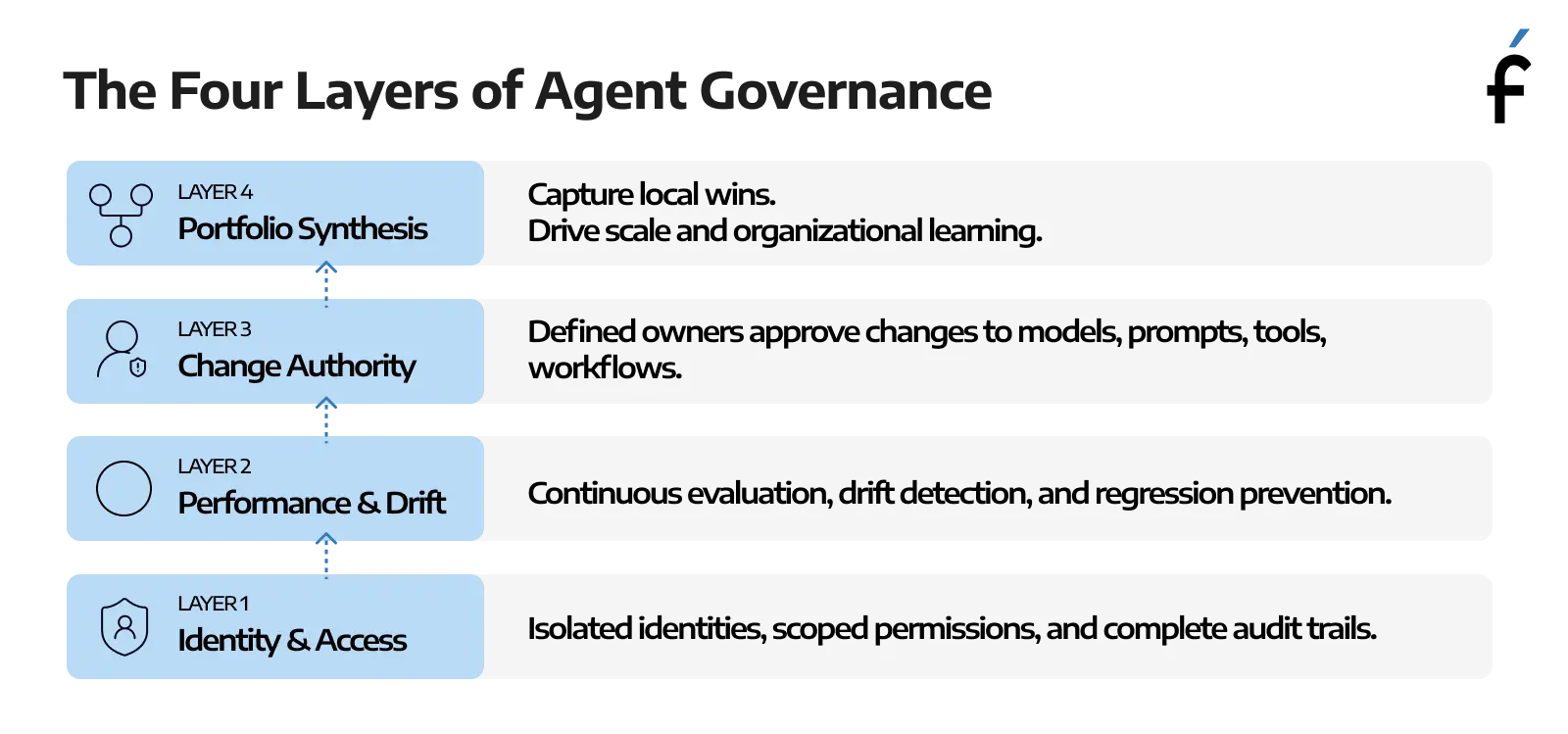
Every agent has a named owner. Every change to the agent (model version, prompt, tools, knowledge base) goes through a defined process with explicit approval authority. Every change is logged, reversible, and tied to a measured outcome.
This is what people mean when they say "governance" without understanding what governance actually is. Not a policy, but a workflow with named accountability, in your actual change management system. If your agent changes do not show up in the same pipeline as your code changes, you have two operational realities and your governance is fictional.
This is the layer that turns local wins into organizational capability. A standing function (a Center of Excellence, a Frontier Firm office, whatever your organization calls it) captures patterns from individual agent deployments and codifies them. Reusable evaluation suites. Reusable orchestration patterns. Reusable workflow templates.
Without this layer, every team rebuilds governance from scratch. With this layer, the marginal cost of governing the next agent collapses, and your portfolio compounds.
The 21% of organizations Deloitte identifies as having mature agent governance? They are the ones who built this layer. The other 79% are still treating each agent as a one-off project.
A working agent is a small set of artifacts that actually run your operation. Here is what the minimum viable version looks like in a real engineering organization:
That is the minimum. Organizations that try to skip any one of these layers end up rebuilding it after their first major incident, usually at three times the cost and under regulatory pressure.
There is a temptation, especially in leaner engineering organizations, to defer governance until the agent footprint is "big enough" to justify it. This logic seems reasonable. It is wrong.
Governance is exponentially harder to retrofit than to build. The first ten agents in your environment will shape every habit, every credential pattern, every audit boundary that follows. Get them right and the eleventh agent inherits a model. Get them wrong and you are not governing agents. You are excavating archaeology.
Three things compound while you wait:
The hard truth: if you are running engineering at a company that intends to deploy agents at scale in 2026, your competitors are not racing you to deploy more agents. They are racing you to govern them. The 21% who have mature governance models will spend 2027 compounding their AI advantage. The 79% who do not will spend 2027 cleaning up incidents.
If you do not have a governance model today, do not start by writing one. Start by inventorying what you already have running.
This is not theoretical. It is the same pattern Forte Group has applied with enterprise clients across financial services, healthcare, and SaaS, and it is the pattern documented in our recent case study. The mechanics are well understood. What is missing in most organizations is the decision to start.
The agents are already in your stack. The question is not whether you will govern them. You will, eventually, one way or another. The question is whether you build the governance model deliberately, before the first major incident, or assemble it retroactively after a regulator, a customer, or a board member starts asking pointed questions.
Capability is no longer the bottleneck. Cost is no longer the bottleneck. Speed is no longer the bottleneck. Governance is the bottleneck, and the organizations that solve it in 2026 will be the ones whose AI investments compound in 2027 and beyond.
Build the registry. Build the evaluation harness. Name the owners. Establish the change authority. Synthesize the portfolio. Do it before you deploy the next ten agents, because the cost of retrofitting all of this once you have a hundred is an order of magnitude higher than building it now.
The 79% are not going to wait. Neither should you.


83% faster delivery. Under 10% rework. See exactly how Xceptor got there.

.jpg)